Showing posts with label YouTube. Show all posts

Caught (1949)

Caught (1949) is a film noir melodrama from Max Ophüls starring Barbara Bel Geddes, Robert Ryan and James Mason, laying bare the perils of middle class marriage and the bullying and controlling which waits any eager young bride, keen to live the fantasy life which the magazines of the time were selling.

Caught is a film which appears more vicious the closer we look at it. 

To kick off, we have some young women who are planning to live their lives through catalogues, an excellent introduction to the mating game as America enters the 1950s.

It is stressed over and over again, in fact. Young model Maude, who changes her name to a more charming 'Leonora', played by Barbara Bel Geddes is seen with her friend and flatmate Dorothy (played by Natalie Shafer) constructing the fantasy life she shall lead via the pages of the many magazines and lifestyle publications that occupy their evenings in their rather downbeat and crummy digs.

Kiss of Death (1947)

Kiss of Death (1947) is a psychopathic traumatic sttol-pigeon crime procedural film noir, featuring Victor Mature as a troubled ex-con; Brian Donlevy as a firm, fair and forgiving Assistant DA; Richard Widmark as a crazed psychopath; and Collen Gray as a sweet and innocent goody-two-shoes, the type of woman in fact beloved of all film noir scenarios, the guiding angel flying in the fateful face of sexual lust and loose living.

An all-American woman perhaps, certainly offering morality and everything else in line with the cinematic Code of operation.

The semiotic valuations which lead to the promotion of one family ideal, and the extinction of African American life in the process, was a bold attempt by Hollywood to attempt to mythify the American way of life into a set of values that all would adopt.

While similarly in this case being spooked up to high heaven by the emerging figure of the psychopath. And that with one of the greatest psychopath's in film history. Noir is its own set of cultures and ideas, and is roughly speaking, a set of conventions defining perception in limited and predictable ways within just about any picture of American life you might care to inject it into.

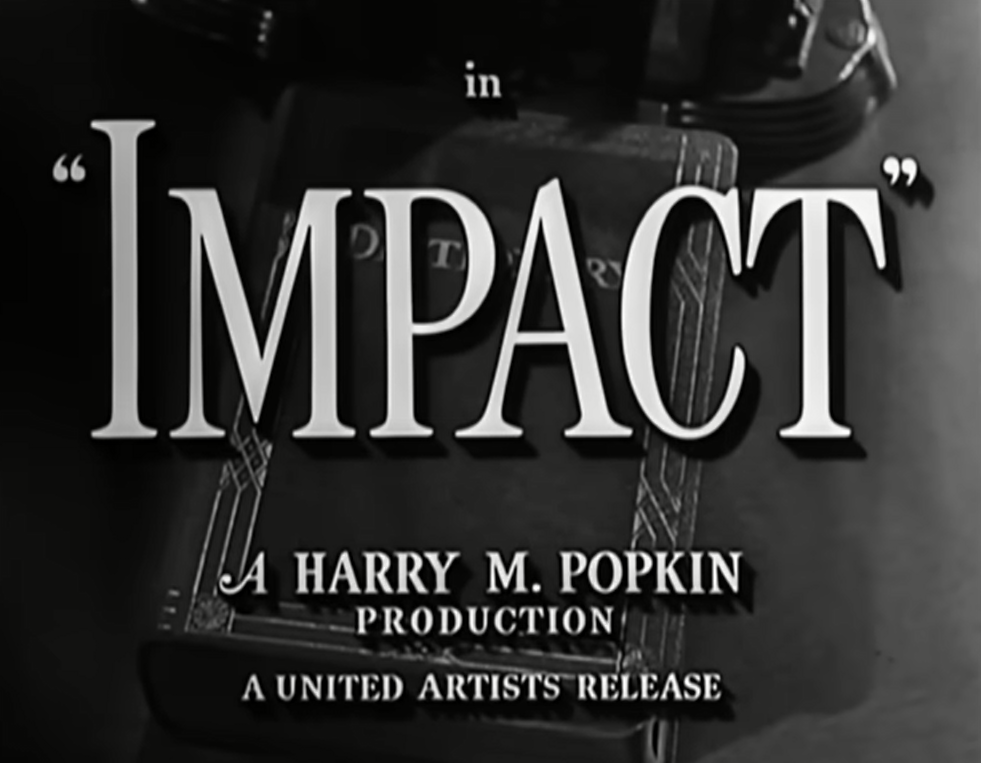
Impact (1949)

Impact (1949) is a film noir classic of confusion, plot twists, identity and love and follows the mishaps and fateful fortunes of industrialist Walter Williams, played by Brian Donlevy.

What makes Impact an impactful film noir as opposed to a plain old drama, is the twisted plot around the successful industrialist's marriage. 

As grouchy as an old bear, his wife sits around at home, the very epitome of the scheming wife, out for what she can get, and of course plotting murder.

A marriage made of monogrammed shirts and pyjamas is helpful for plots like this. Much is made of the bizarre accidentals which lead poor Walter Williams from the heights of success to the lows of small-town isolation, such as the odd device of the domestic assistant Su Lin (played by Anna May Wong) overhearing what she thinks is a threat, when in fact it's a husband larking around with his wife.

The duplicitous wife in Impact (1949) is here writ heavy in the form of Helen Walker, who plays the Irene Williams, the lady behind the plot to kill. Like a good deal of solid noir, Impact is a marriage fantasy, the likes of which 1940s film noir specialised in. 

By this we demonstrate a wife who is so ill-suited that she is planning your murder, and a wannabe love that turns up out of nowhere, already embodying the American dream, and valuing love above cash - a perpetual dilemma. 

Hidden Fear (1957)

Hidden Fear (1957) is something of a curiosity at the tail end of the film noir cycle, and that curiosity largely arises from the fact that it is set in Denmark.

The logic behind this is not clear, and some of the film in general suffers from this lack of clarity too.

Some of the more obvious film noir strings are not pulled, and were it not for John Payne in the lead role, bullying and slapping his way around the Danish capital, there may not be much noir left at all to enjoy.

Hidden Fear is a linear thriller, which does its best to make a virtue of its location shooting, but does not manage to raise any particular tension, or find any depth in its stroll through the Danish underworld.

Decoy (1946)

Decoy (1946) is a low budget, cheaply plotted film noir thriller and shocker, premised on an idea that has elements in common with horror, as it re-animates a dead con in a miraculous escape from death row.

The source of the drama is easily stressed -- it's a box with $400,000 in it, the proceeds of a robbery.

And the leading actor in the villainous and double crossing pursuit of this box, is an energetic and deadly femme fatale performance from Jean Gillie, a British actor in her first American film role.

Actor Jean Gillie had a short, short life and Decoy, for all its ills and budgetary constraints was her penultimate film role.

For a film that doesn't boast much in the way of star performances, or glorious set pieces, Jean Gillie gives a helluva lotta goods in this short and at times brutal film noir.

The Man With The Golden Arm (1955)

The Man with the Golden Arm (1955) is a film noir with  flavours all of its own — whether it be the Saul Bass credits or the theme of heroin addiction — both new elements for 1955 and in their own ways the signs of a new age approaching in cinema.

Frank Sinatra memorably plays the lead in Otto Preminger's adaptation of Nelson Algren's novel, with Kim Novak supplying a sympathetic role beside him, his light indeed in the dark city of film noir, which admittedly is not so very dark here — at least in tone. 

Frank Sinatra plays Frankie Machine, an illegal card dealer and recovering heroin addict who gets out of prison, with a new talent — he's learned the drums. 

On the streets and looking for a jazz band gig, Frankie Machine is inevitably sucked back into the life, encountering all the perils of the familiar noir city — from shady businessmen to vulnerable women, via small-time con men to temptation itself.

For You I Die (1947)

For You I Die (1947) is a low budget thriller of an innocent con on the run.

Kicking off in a sewer, two characters are thrust out of the void and into their own noir universe. 

Tense, nervous, fighting their way from the lowest and worst of all locales, to attain some kind of freedom and decency.

That’s Noir, living in a sewer for three days, desperate and on the run, trying to get some clothes, trying to get some dough, trying to get to San Francisco.

Two of the lowest of the low in the cheapest of the cheapest of sewers are on the run in the land of the free.

And this is where film noir enjoyed taking us in the 1940s. The enjoyment of life is there in other people, in those whom we love and trust.