Showing posts with label George Raft. Show all posts

Scarface (1932)

Scarface (1932) (also known as Scarface: The Shame of the Nation and The Shame of a Nation) is a classic pre-code Howard Hawks Howard Hughes criminal madman mobland 30s scarred gangster social statement on crime shocker blazing with the irresistible firepower of a machine gun and concerning and creating the self destructive and excessive mythology of the American career gangster cinematic landmark ugly and brilliant rise and fall OG gangster film x-marked and nation shaming historically significant classic proto noir movie which can be studied and enjoyed by all noir fans and cineastes, and based of course on Scarface (1930 novel) by Armitage Trail.

Whistle Stop (1946)

Whistle Stop (1946) is a film noir tale of crazed small town jealousy bursting at the seams with a lousy husband and lousy boyfriend competing over the most beautiful woman of all time in a booze-based gamblathon with train image-ery a-plenty and passing trains and honking trains obviously while whistle stop motifery abounds in a darkened noir manner at the end of hope, as George Raft employs his incredibly still face, and Tom Conway twitches his most incredibly smooth and moustachioed face, and both faces are punched in booze-based and non booze-based rage, and Ava Gardner deploys her incredibly beautiful face.

A Dangerous Profession (1949)


A Dangerous Profession (1949)
is a stylised pulp cop versus bail-bondsman versus client stand-off romance crime and detective mystery mannered film noir directed by Ted Tetzlaff, and starring Ella Raines, George Raft, Jim Backus and Pat O'Brien.

The tough loners of film noir are always waiting for a new case in the city of crime, whether they be detective or heel, or in this case a bail bondsman, something of the perfect cinematic loner. 

Some of them are waiting for the return of the woman that burned them, and George Raft plays both, with his usual stillness and impassive stone hard cinematic stare.

In the game of sucker moves, this loner works his broken relationships with broken noir charm, the grimaces of both his current partner and his former police partner testify to this.

The Glass Key (1935)

The Glass Key (1935) is an underworld of politics and crime thriller that is not film noir but well may be a proto-noir, but is an adaptation of a seminal Dashiell Hammett novel, later remade into a more lavish effort in 1942.

In the dimly lit chambers of literary discourse, where the flicker of candle flames dances upon the parchment, let us embark upon a journey through the labyrinthine corridors of this narrative. 

The tale that unfolds before us, like the intricate workings of a Victorian pocket watch, neither wears the gilded mask of merriment nor the embroidered cloak of frivolity. Nay, it treads the murky path of shadows and secrets, where the echoes of footsteps linger long after the last page is turned.

Our protagonist, Ned Beaumont, emerges from the fog of obscurity—a man of enigmatic countenance, his features etched by the chisel of fate. 

Black Widow (1954)

Black Widow (1954) is a colour DeLuxe mystery Broadway cocktail suicide murder CinemaScope motion picture with film noir leanings. 

Attention spans alerted everyone this slider of a slow noir is another object lesson in the class of colon noirs which feel their way in a cinematic dark so much of the time and are managerially staid with a tragic inability to fill the vacant screen space created by colour-vision and wide screen tech. A double whammy of screen emptiness.

Come diving headlong into the murky waters of a slow burn noir flick that's as sluggish as a slug on a warm sidewalk. This one's a textbook case of those colour noirs that stumble in the shadows, groping blindly through the cinematic darkness, like a gumshoe with one too many shots of rum, yum. Yeah, it's got all the fancy-pants tech — living colour, widescreen — but it's like watching paint dry in a rainstorm. A double-barreled blast of cinematic emptiness that hits you square between the eyes.

Johnny Angel (1945)

Johnny Angel (1945) is a maritime gold heist mystery murder romance adventure film noir set in New Orleans.

With a sterling film noir cast in George Raft, Claire Trevor, Signe Hasso and Marvin Miller — along with unique local support from Hoagy Carmichael — Johnny Angel is a complex adventure tale set in part at sea and in part in and around the city of New Orleans.

Johnny Angel (1945) was written by Steve Fisher, who had many interesting film noir and Western titles in his credits, including the novel which inspired I Wake Up Screaming (1941) and screenplays for Lady In The Lake (1946), Dead Reckoning (1947), The Hunted (1948), Woman They Almost Lynched (1953), City That Never Sleeps (1953), and Hell's Half Acre (1954) to name a few favourites.

You and Me (1938)

You and Me (1938) starring George Raft and Silvia Sidney is an early film noir from Fritz Lang, set in a department store which is staffed by criminals on parole.

Delightful within You and Me is the German expressionist sensibility which is quite apparent in the photographic style, but which the American audiences may not have been quite ready for. 

Most especially in the scenes where the large criminal gang are together, there is a certain flavour of the director's earlier film M (1931), stylised at times by the actors facing directly into the camera to achieve an arresting effect — as well as powerful and small touches which carry great weight.

Likely the most memorable of these describes the relationship between the two young lovers George Raft and Sylvia Sidney, whose hands touch as they pass on an escalator. The way this shot is managed speaks volumes, and in the midst of a chaotic crime caper, which to be fair has as many romantic and screwball aspects to it as it does full film noir flavour, it's among the most powerful of moments.

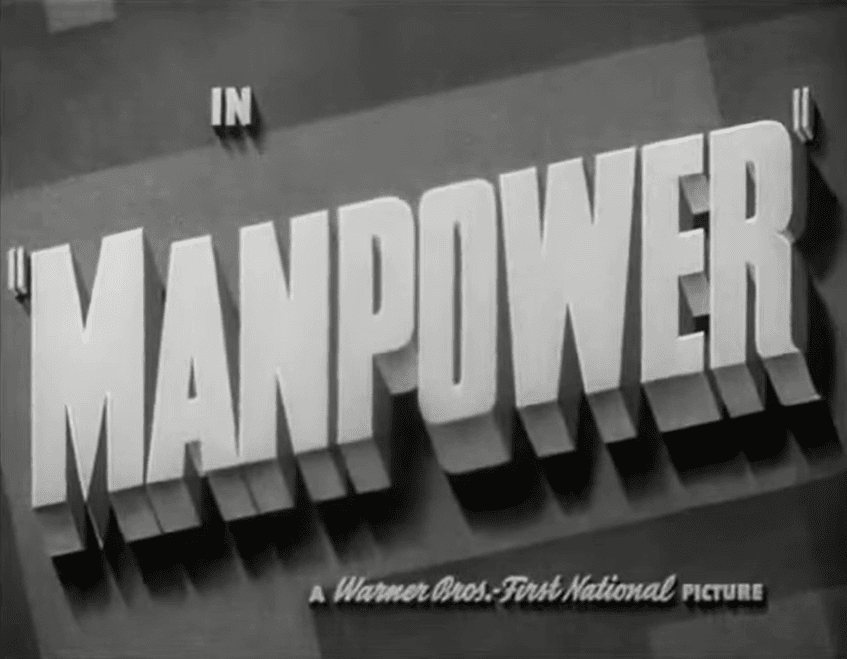
Manpower (1941)

Manpower (1941) starring George Raft, Marlene Dietrich and Edward G. Robinson is deserving of an honourable mention on classic film noir, for the habits it portrays and social directions  it takes.

While likely classifiable as a dramatic film with comic elements, Manpower still has something to relate to noir audiences. 

The story is about two friends and their supportive relationship, and essentially portrays the bonds between working men and their women. 

The slapstick jollity of the era is well captured and has certainly, as comedy usually does, aged poorly. Edward G. Robinson's character in hospital is styled as an 'octopus' because of the way his hands grab the nurses. And this is the least of it. 

They Drive By Night (1940)

A box office hit in its day, They Drive By Night (1940), with George Raft, Ida Lupino, Ann Sheridan and Humphrey Bogart is a film noir trucker movie, which opens on the embattled lives of some West Coast fruit hauliers, and closes on murder, madness and corporate corruption ― as obsession and madness destroy femme fatale Ida Lupino’s life.

The rub is that director Raoul Walsh had a flair for subverting genres, and really only made what you might call “Raoul Walsh pictures” whatever the basic  genre ― and this one is about as Raoul Walsh as you can get.

It’s a trucker movie, it’s a comedy, it’s a romance and it’s a thriller. It’s a picture about class relationships and the cutthroat nature of business; and it’s a picture about madness and the little guy rising to the top.

Raoul Walsh ― who also made the following film noir favourites ― High Sierra (1941); Pursued (1947); and White Heat (1949) ― had a feeling feeling for regular people, informal surroundings, and he portrays the hustle and bustle of working life very well.

Intrigue (1947)

In post-war China, a disgraced former USAF pilot flies smuggled goods into the country. 

He attempts to force his immediate superior, Ramon Perez (Marvin Miller), to pay him more, but Perez resists, so Brad steals the cargo back.

Intrigue (1947) is not featured on the great and many bountiful film noir discussion websites and books because it is a classy example of the film noir style. 

It does however bear repeat viewing, and combines noir underworld themes with geo-politics and American foreign policy, to create an interesting set of circumstances in post-war China ― narrative forming, and not racially aware in a fashion that was not uncommon in the 1940s, although it has no intention to offend.

Intrigue’s intention in fact, as its happy ending ― an element which pulls it away from its underworld noir roots, as well as the rootless and entrepreneurial criminality portrayed by George Raft, as it central character.

Unlike many a noir hero, because he is in fact a  war hero. George Raft as Brad Dunham comes good ― he’s great with the kids, which we see in several quite uncomfortable scenes in which young Chinese actors make jokes about Brooklyn and George Raft ruffles a lot of hair. And there is the happy ending.

This is war after all, and foreign policy. Via the powers of journalism, the morally dubious become virtuous and all star American values are installed.

Nocturne (1946)

Nocturne (1946) is a full-on film noir moody mystery melodrama, produced by long-time Alfred Hitchcock associate Joan Harrison. 

Within the excellent opening photography, we witness rakish Hollywood composer (Edward Ashley) dropping dead in his swanky Hollywood house.

The film noir police force think it's a straight up suicide, but maverick lieutenant hero Joe Warne (played by George Raft) suspects murder.

With no hanging about, Warne discovers that this Hollywood composer has broken the hearts of at least ten women in recent years, offering motive for murder aplenty.

The main suspect is Frances Ransom (played by Lynn Bari), who may or may not have been avenging her sister, the nightclub thrush Carol Page (Virginia Huston). 

Pursuing the case with enough firm diligence to get him at one stage thrown off the police force, determined copper Joe Warne of course refuses to give up.

There is a hint here of a sub-genre that would become larger by far as the years passed, the dark side of Hollywood as film noir, which remained popular as much among the community itself, as it was with the theatre-visiting public. Hollywood loves to film itself, murdering itself. In that glorious, glamourous heart, there is always a corrupting influence to be found. 

A Bullet for Joey (1955)

The curious late-cycle film noir gangster-spy picture A Bullet for Joey (1955) unites the two stars Edward G. Robinson and George Raft,  who had previously been paired in Raoul Walsh's Manpower (1941).

Edward G. Robinson was at ease in film noir, and able to play good guy roles, which he often did with pipe-wielding authority, and out and out villains. 
George Raft in A Bullet For Joey plays the hoodlum figure, working here to kidnap a nuclear scientist, with Peter van Eyck as the true ring-leader.

Comparing it to Illegal (1955), also with Robinson and by director Lewis Allen, there is slightly less in terms of dark city noir qualities, paranoia, and psychological damage.

In Montreal, a police inspector (Edward G. Robinson) uncovers piece by piece a plan to kidnap a nuclear physicist. American mobsters, foreign spies and a blonde seductress are all involved in this rather staid caper.

Shout out, however, to monkeys in film noir.

Invisible Stripes (1939)

Invisible Stripes is (1939) starring George Raft, Humphrey Bogart, Jane Bryan and William Holden, is one of those great 1930s movies that lays down some of the rails upon which film noir would soon enough run.

If it's a crime film, if it's a prison film, or if it's a heist film, the chances are that in the Golden Age of the silver screen, this movie may be presented with all the tropes, style and wisdom of film noir.

It's often true, but it also ain't necessarily so. Nobody rushes to call the Falcon films, or the Basil Rathbone Sherlock Holmes films film noir ... and yet they deal in crime, conspiracy, and often in the shadows and fog.

The prefiguring of film noir is still quite evident in 1930s cinema. To find it, one can trace the morality of the crimes, cops, robbers, murderers and increasingly, the psychopaths and the teenage tearaways.

Film noir prefiguring aside, Invisible Stripes, directed by Lloyd Bacon is a lot of fun, and acts out that fine 1930s theme of the kids on the street battling with the urge to turn to crime. It's in this environment, that director Lloyd Bacon brings home a few new ideas, including that of the teenage tearaway.

And that tearaway, is committing a certain form of crime, against both the combined moral wealth of the family, and society itself.