Showing posts with label Ward Bond. Show all posts

A Man Alone (1955)

Übrigens ist er nicht in der Ray-Milland-Saison enthalten.

A Man Alone (1955) is a Ray Milland directed and starring revenge framed man adventure romance angry mob and innocent man wrongly accused father down with a fever nobody's blamin you can make up your own mind, my word against his dangerous man noir inflected gunman film western directed by and starring Ray Milland as Wes Steele, Mary Murphy as Nadine Corrigan, Ward Bond as Sheriff Gil Corrigan, Raymond Burr as Stanley, Arthur Space as Doctor Mason, Lee Van Cleef as Clanton and Alan Hale as Acting Sheriff Jim Anderson.

Swamp Water (1941)

Swamp Water (1941) is a moody southern innocent-man-accused rural-backwater pelter manhunt film noir, which was Jean Renoir's first American movie.

A surprise treat from 1941, Renoir brings some poetic magic to the early years of the Golden Age, by taking time to develop characters and also developing the fact and fiction of the swamp itself, bringing on the sticky everglades as a peril as lousy as the urban jungles of more familiar film noir.

More complex and sad also, than the more common fare of the day, Swamp Water (1941) teases out feeling and emotional pain from the cast in the small town jealousies of its actors, and even a scene of torture in which Dana Andrews' character is drowned for information on the whereabouts of Walter Brennan's character.

Kiss Tomorrow Goodbye (1950)

Kiss Tomorrow Goodbye (1950) is a bitch-and-towel slappin violent anti-social criminal psychopath flashback murder courtroom film noir with the king of the noir loons himself James Cagney as a no nonsense violent career criminal en route to hell.

Ralph Cotter, a hardened criminal with a penchant for violence, embarks on a harrowing journey of deceit and betrayal after a daring prison escape turns deadly. 

The death of his escape partner, Carleton, at his own hands sets the stage for a twisted game of manipulation and obsession. Is the love between brother and sister greater than that between gangster and long-suffering moll?

As Cotter insinuates himself into the life of Carleton's unsuspecting sister, Holiday, a dark and disturbing dynamic emerges — a typical web of desire and domination, where passion and pain collide in a volatile mix of emotion. 

Their sadomasochistic bond is laid bare in a chilling scene where Cotter's brutality is met with Holiday's fervent embrace — a stark portrayal of the depths of their depravity. They are American. They are you.

On Dangerous Ground (1951)

On Dangerous Ground (1951) is a classic Nicholas Ray urban rural violent cop film noir starring Robert Ryan and Ida Lupino in a tale of loneliness and duality combining the full and contrasting forces of both the wildscapes of the north and the urban environments on the individual.

Robert Ryan plays Jim Wilson a brutalised city cop, in danger of losing his job due to his lack of control when it comes to managing violence in his job. 

Ida Lupino plays Mary Malden, a blind woman who characteristic of blindness in the movies at the time — is symbolically set to allow the hero to finally 'see'.

G Men (1935)

G Men (1935) is a Proto-Noir Post-Code Warner Bros. crime and police procedural action film starring James Cagney, Ann Dvorak, Margaret Lindsay and Lloyd Nolan in his film debut. 

G Men, one of the top-grossing films of 1935 was a shot at portraying crime successfully within the confines of the newly enforced Hayes Code, by creatively casting crime favourite James Cagney in a non-criminal role -- in this case supporting the law and maintaining the action by becoming a federal agent.

The supporting cast features Robert Armstrong and Barton MacLane and the surrounding tension arises from the fact that Cagney's character, Brick Davis changes sides and bides farewell to the mob boss who financed his education as a lawyer, to become a full on nark, a fed or what passed for it in the long-past and unarmed days of 1935.

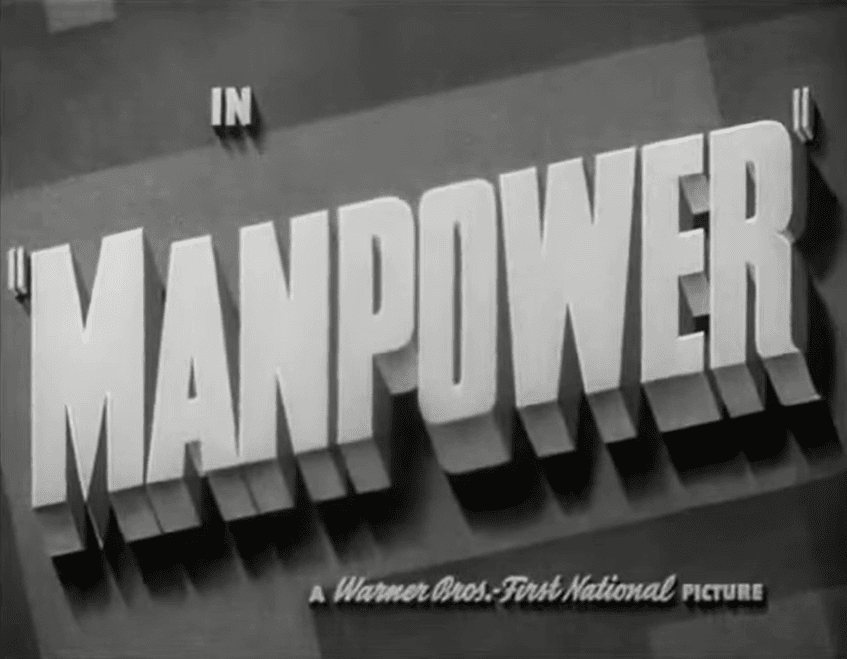
Manpower (1941)

Manpower (1941) starring George Raft, Marlene Dietrich and Edward G. Robinson is deserving of an honourable mention on classic film noir, for the habits it portrays and social directions  it takes.

While likely classifiable as a dramatic film with comic elements, Manpower still has something to relate to noir audiences. 

The story is about two friends and their supportive relationship, and essentially portrays the bonds between working men and their women. 

The slapstick jollity of the era is well captured and has certainly, as comedy usually does, aged poorly. Edward G. Robinson's character in hospital is styled as an 'octopus' because of the way his hands grab the nurses. And this is the least of it. 

Johnny Guitar (1954)

Johnny Guitar (1954) is a bluff and luridly coloured fantasy Western, that has found its way on to the film noir style sheet by dint of its role reversin' fun, and its hard hitting characters. 

Joan Crawford is a saloon owner, holding on tight to her all-American right to stay on her land and not have it bought up by the corporate or in this case local interests who have their own ideas about the railroad that's rolling through.

The townspeople don't want her, for reasons that are not immediately obvious. 

But she has a nemesis; and just as she leads the saloon with its bored but well dressed staff of croupiers, the good townsfolk of this small and wild Arizona settlement, are lead by a similarly dangerous firebrand of a woman, in this case Emma small - - played by Mercedes McCambridge, whose vengeful vendetta seems to want her to see Joan Crawford driven out of town and hanged.

Romance, hatred and violence combine in Johnny Guitar to create one of the most popular noir Westerns in the canon.

The Maltese Falcon (1941)

Despite spectacle, stories and such technical attributes as lighting and special effects, it’s a comfort that the biggest pull in cinema is that vague quantity known as ‘star quality’.

It’s star quality that makes a film noir classic like The Maltese Falcon watchable, even when the plot is failing.  There’s a section about 40 – 50 minutes into The Maltese Falcon in which the story widens out — suddenly there are more adventurers revealed, and a whole lot more in terms of characters and detail — and for those not used to the vagaries of the medium , this is the moment many switch off.

If it weren’t for Humphrey Bogart and Peter Lorre, and the vile duplicity portrayed by Mary Astor, they may even not switch back on again.