Showing posts with label Erskine Sanford. Show all posts

The Magnificent Ambersons (1942)

The Magnificent Ambersons (1942) is a unique Orson Welles classic family drama movie, based on a novel that Welles had already successfully adapted for the radio, but which proved fraught as a film, causing studio issues, re-shooting and editing, with much footage destroyed in the day, and with all the marks of the stressful reaction of the genius Welles, to the cemented industry he sought to evolve.

The Magnificent Ambersons (1942) is indeed in many ways a unique prospect, which while note folks this is not a film noir, it is still a major work from Orson Welles, and the Orsonian contribution to everything we adore was so profound, that inclusion beyond a mention is needed.

Crack-Up (1946)

Crack-Up (1946) is an amnesia fraudulent artwork persecution noir with psychological elements delving into the amazing practise of narcosynthesis, and featuring some great train-bound action as a paranoid art critic played by Pat O'Brien searches frantically for his unknown tormentors.

Directed by Irving Reis, this fast moving art-crime drama also starred Claire Trevor, Herbert Marshall, Erskine Sanford and Wallace Stevens —  a strong film noir showing by any standards.

Dark and mysterious and tugging at undercurrents in the highest echelons of society, as represented by the artworld, Crack-Up has an uncanny feel, largely brought about by its quite distinctive paranoid train sequences.

Citizen Kane (1941)

Citizen Kane (1941) is not considered to be an example of film noir and yet there would barely be one reel of classic film noir at all were it not for this American drama film directed by, produced by, and starring Orson Welles.

Also starring Joseph Cotten and the players of the Mercury Theatre Citizen Kane appears right at the start of the great film noir years, and was released in same year as The Maltese Falcon, High Sierra and I Wake Up Screaming — all of which are full fat noir, proving the style was already underway.

At the same time, there's a case to be made for the fact that Citizen Kane is the archetypal, primal, principal and inceptive American film noir production.

Citizen Kane is not a crime film and does not feature any murder, femmes fatales, post-war anxiety, paranoia or otherwise any saps, heels, mooks, cops, roscoes, police procedural brutality or wandering palookas astray in an alienating urban environment.

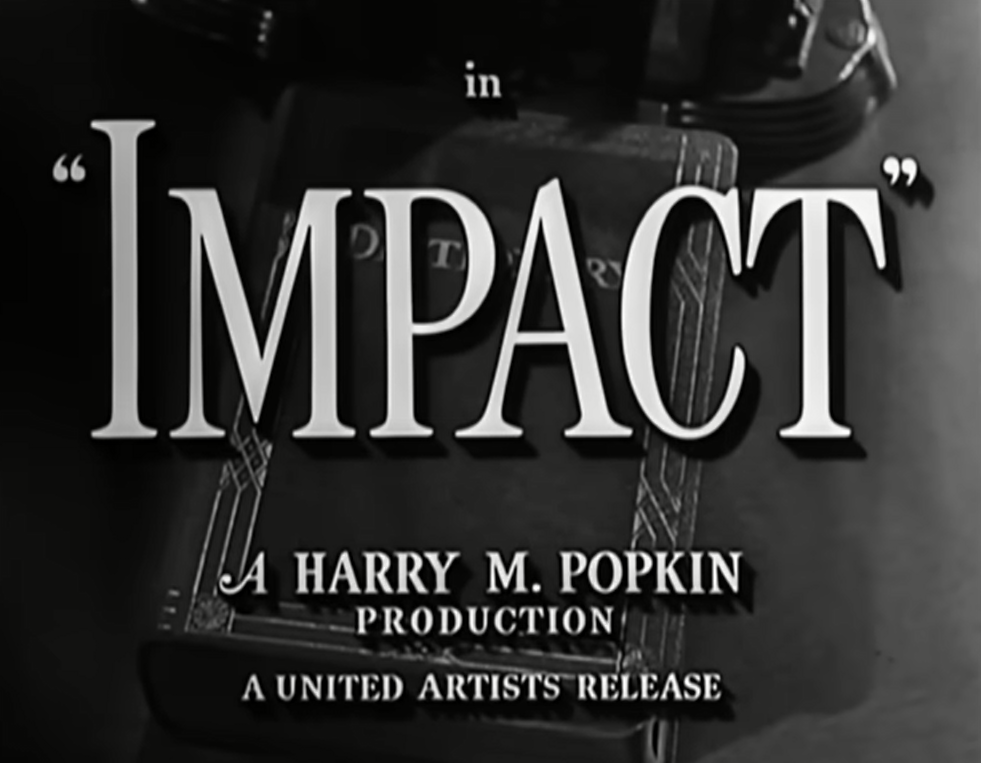
Impact (1949)

Impact (1949) is a film noir classic of confusion, plot twists, identity and love and follows the mishaps and fateful fortunes of industrialist Walter Williams, played by Brian Donlevy.

What makes Impact an impactful film noir as opposed to a plain old drama, is the twisted plot around the successful industrialist's marriage. 

As grouchy as an old bear, his wife sits around at home, the very epitome of the scheming wife, out for what she can get, and of course plotting murder.

A marriage made of monogrammed shirts and pyjamas is helpful for plots like this. Much is made of the bizarre accidentals which lead poor Walter Williams from the heights of success to the lows of small-town isolation, such as the odd device of the domestic assistant Su Lin (played by Anna May Wong) overhearing what she thinks is a threat, when in fact it's a husband larking around with his wife.

The duplicitous wife in Impact (1949) is here writ heavy in the form of Helen Walker, who plays the Irene Williams, the lady behind the plot to kill. Like a good deal of solid noir, Impact is a marriage fantasy, the likes of which 1940s film noir specialised in. 

By this we demonstrate a wife who is so ill-suited that she is planning your murder, and a wannabe love that turns up out of nowhere, already embodying the American dream, and valuing love above cash - a perpetual dilemma. 

Ministry of Fear (1944)

Ministry of Fear (1944)
is an espionage dream Nazi spy thriller starring Ray Milland, presenting an almost surreal succession of events and clues as one man is sucked further into a murderous Nazi spy plot as he inadvertently receives something the enemy agents are after — in a cake which he wins at a bizarre midnight village fete.

The Nazis in Fritz Lang's film noir mid-war favourite Ministry of Fear aren't presented in the typical style of the day.

The Nazis in this film noir classic don't wear swastika armbands and nor do they make fascist speeches about the benefits of the Reich's new order, a sight common enough from other mid-War propaganda.

There were many films made about WWII, during WWII. The movie Nazis that made the most impact at the time were in the style of the pompous evil-doers of films like Sherlock Holmes And The Voice Of Terror (1942); or Sherlock Holmes and the Secret Weapon (1943).