Showing posts with label Raoul Walsh. Show all posts

Colorado Territory (1949)

Colorado Territory (1949) is a Raoul Walsh train-heist noir western remake of the director's own class act 1941 film noir High Sierra.

Colorado Territory is a fun-laced trawl through the mental badlands of the noirish west making live action commitment to many facets of the styles beloved of the era, both the noir, and the west, the male staples of the period.

Raoul Walsh's Colorado Territory (1949) is, yes here we are to say it for once and for all, my God it doth do stand as a testament to the director's ability to transmute his earlier noir creations into the stark, rugged aesthetic of the Western genre. 

White Heat (1949)

White Heat (1949) is the ultimate white hot gangster semi-documentary heist prison movie in the entirety of the classic film noir canon.

Super hot action and direction from Raoul Walsh flings James Cagney, Edmond O'Brien and Virginia Mayo into some of the best acting of their lives, elegantly supported by Steve Cochran

This explosive exploitation noir comes in at a huge length of nearly two hours.

White Heat (1949) is a multiple set of movies, seeming to smash them together at high speed, very much like the train which kicks the picture off, emerging from the tunnel to be robbed by the gang.

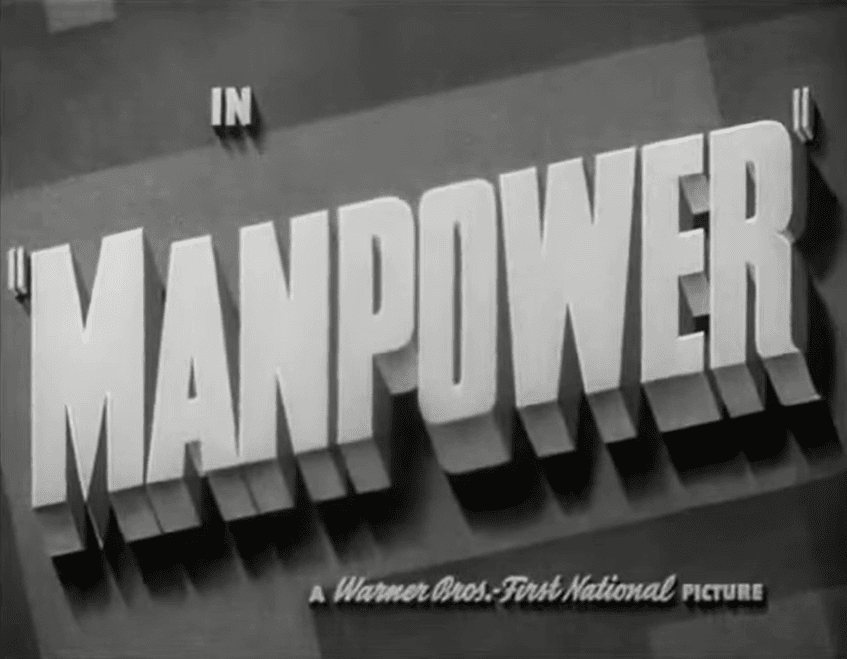
Manpower (1941)

Manpower (1941) starring George Raft, Marlene Dietrich and Edward G. Robinson is deserving of an honourable mention on classic film noir, for the habits it portrays and social directions  it takes.

While likely classifiable as a dramatic film with comic elements, Manpower still has something to relate to noir audiences. 

The story is about two friends and their supportive relationship, and essentially portrays the bonds between working men and their women. 

The slapstick jollity of the era is well captured and has certainly, as comedy usually does, aged poorly. Edward G. Robinson's character in hospital is styled as an 'octopus' because of the way his hands grab the nurses. And this is the least of it. 

They Drive By Night (1940)

A box office hit in its day, They Drive By Night (1940), with George Raft, Ida Lupino, Ann Sheridan and Humphrey Bogart is a film noir trucker movie, which opens on the embattled lives of some West Coast fruit hauliers, and closes on murder, madness and corporate corruption ― as obsession and madness destroy femme fatale Ida Lupino’s life.

The rub is that director Raoul Walsh had a flair for subverting genres, and really only made what you might call “Raoul Walsh pictures” whatever the basic  genre ― and this one is about as Raoul Walsh as you can get.

It’s a trucker movie, it’s a comedy, it’s a romance and it’s a thriller. It’s a picture about class relationships and the cutthroat nature of business; and it’s a picture about madness and the little guy rising to the top.

Raoul Walsh ― who also made the following film noir favourites ― High Sierra (1941); Pursued (1947); and White Heat (1949) ― had a feeling feeling for regular people, informal surroundings, and he portrays the hustle and bustle of working life very well.

The Man I Love (1947)

The Man I love (1947) is not the most classifiable of film noir productions from the 1940s but it does say plenty about the style and the era.

It's also potentially a rare film noir in that it attempts to close in on the female experience of family life, dating, night life and petty criminality. Gender roles are clear in The Man I Love, as they are in all cinema of the 1940s. But they are still overturned in places.

And if you have found the overturning of social norms in the cinema of the 1940s, you have almost always certainly found film noir, even if your movie doesn't feature paranoia, corruption and the dark criminality and murder more normally associated with the style.

The Man I Love is not an immediately obvious placement in the film noir canon, and yet with its female seeker hero in the form of Ida Lupino, working her way through night clubs on the West Coast, this film has noir chops to spare.

High Sierra (1941)

Although High Sierra (1941) is likely perceived by the public as a ‘Humphrey Bogart’ picture, it is not entirely fair to see it that way. 

Indeed, High Sierra is notable in many ways for how Ida Lupino’s character develops, and how she is portrayed. 

Viewers will also note that Ida has top billing too, before Bogart, and that is worth something!

Critically, Ida Lupino plays a fairly ‘straight’ role here, and hers is not a character the readily fits into the various tropes and stereotypes which it is often said, dominate the female portrayals in the style.

By ‘straight role’ we can confidently say the following of Ida Lupino in High Sierra ― her character is consistent and develops across the course of the action. 

While not cast as a femme fatale, or domestic simp of some sort, Ida's character, Marie, falls in love with Humphrey Bogart’s character, Roy, and remains true to the end. The entire episode is presented as her story, and her journey, with the viewer experience being hers.

Conversely, Bogart’s character is typical of a certain type of male from this era of film noir ― he may try to be doing good, but fate and his lower nature are in fact in control. 

This means Roy Earle (Bogart) regularly makes wrong decisions, and not just when he is railroaded into them. 

The Enforcer (1951)

Who is The Enforcer?  

Is it Humphrey Bogart who plays District Attorney Martin Ferguson, the guy who enforces the law, slapping hoods where necessary, an enforcer of morals in a sick crime game?

Is The Enforcer Everett Sloane as Moriarty-like mastermind Albert Mendoza, a man so feared in the city that even the mention of his name enforces a certain silence, an absolute fear, the inevitability of a violent death? 

Or is The Enforcer tough guy turned snivelling snitch, Rico, played by Ted De Corsia, whose king-pin status keeps the whole racket going; Rico who enforces the deadly conviction of the mysterious boss man, until his own nasty death?

It is not possible to keep track of the flashback-cum-story within a story structure of The Enforcer.  The first ten minutes take place near the end of the story, and from thence the editor dives to the start, periodically dipping further into the past as hood and victims tell their stories, generally to Ferguson, the character played by Bogart.