Showing posts with label Gene Tierney. Show all posts

Leave Her To Heaven (1945)

Leave Her To Heaven (1945) is a psychological thriller toxic love and 1940s psychopath-styled state-hopping powerful female lead with undiagnosed ADHD Technicolor sophisticates in frocks writer hero high-grossing classic film noir melodrama, with Gene Tierney, Cornel Wilde, Jeanne Craine and Vincent Price.

One of the most intriguing questions regarding Leave Her To Heaven (1945) is why it was Twentieth Century Fox's highest grossing film of the decade. 

The Razor's Edge (1946)

The Razor's Edge (1946) is an intergenerational returning veteran historical drama episodic male point of view romance adventure two and a half hour Somerset Maugham worldliness versus spirituality adaptation which was a huge romantic hit in its time, and which owes little to film noir, but offers a stable and repetitive cascading style of romance story that is a soft-soap kind of storytelling, offering the purest kind of escape known to 1946.

This is not a film noir, and yet within it lurks the genes of the style not quite activated, but present as the underscored factual spiritual well from which draws a grabbing interest, between the snogs and high-class encounters. In the 1940s they did not have slacker movies, but they did have loafer movies, and this is one.

The Secret of Convict Lake (1951)

The Secret of Convict Lake (1951)
is a pressure cooker ensemble cast prison break snow-bound gang on the run innocent-man-accused Western movie with film noir tendencies aplenty and a few side comments too on the social roles of men and women, as such relate to heroism, homesteading and justice.

The 1951 Western The Secret of Convict Lake emerges as a unique entry in the genre, distinguished by its noir-inflected atmosphere and an unusually strong female presence. 

Directed by Michael Gordon, the film tells the story of a group of escaped convicts who, after enduring a harrowing journey through the snow-covered Sierra Nevadas, stumble upon a remote settlement populated solely by women. 

The Iron Curtain (1948)

The Iron Curtain (1948) is an early Cold War espionage and infiltration thriller based on the breaking up of a real Canadian spy ring in the immediate aftermath of World War 2. 

It didn't take long, but shortly after World War 2 ended it became apparent that the liberators of Berlin and the nation which defeated the Nazis in Germany became the main enemy of the United States, and by association here, and everywhere, Canada.

It is in fact by all accounts the first feature film to dramatize and propagandise the new-fangled Cold War of the period, which could really be said to have run from 1947 until 1991, and seen the rise and development of film noir as one of its key cultural expressors.

Black Widow (1954)

Black Widow (1954) is a colour DeLuxe mystery Broadway cocktail suicide murder CinemaScope motion picture with film noir leanings. 

Attention spans alerted everyone this slider of a slow noir is another object lesson in the class of colon noirs which feel their way in a cinematic dark so much of the time and are managerially staid with a tragic inability to fill the vacant screen space created by colour-vision and wide screen tech. A double whammy of screen emptiness.

Come diving headlong into the murky waters of a slow burn noir flick that's as sluggish as a slug on a warm sidewalk. This one's a textbook case of those colour noirs that stumble in the shadows, groping blindly through the cinematic darkness, like a gumshoe with one too many shots of rum, yum. Yeah, it's got all the fancy-pants tech — living colour, widescreen — but it's like watching paint dry in a rainstorm. A double-barreled blast of cinematic emptiness that hits you square between the eyes.

Laura (1944)

Laura (1944) is a classic murder mystery web of love film noir drama of meagre and unhealthy male obsession directed by Otto Preminger, starring Gene Tierney, Dana Andrews, Clifton Webb and Vincent Price.

The premise of the story is that three men are fixated on the one woman, Laura Hunt, and as the story starts we visit one of those men — Waldo Lydecker, played by Clifton Webb — in the company of another of them, the young cop Mark McPherson, played by Dana Andrews.

The classic film noir flashback structure allows for a multitude of mystery and nonstandard storytelling, much of this confused by the fact that Waldo Lydecker is a brittle and caustic storyteller in himself — he is a famous columnist and aside from the power that he wields — typing his sometimes vitriolic and career-ending columns for his bathtub — he is in fact a weaver of tales himself and as such should not be trusted.

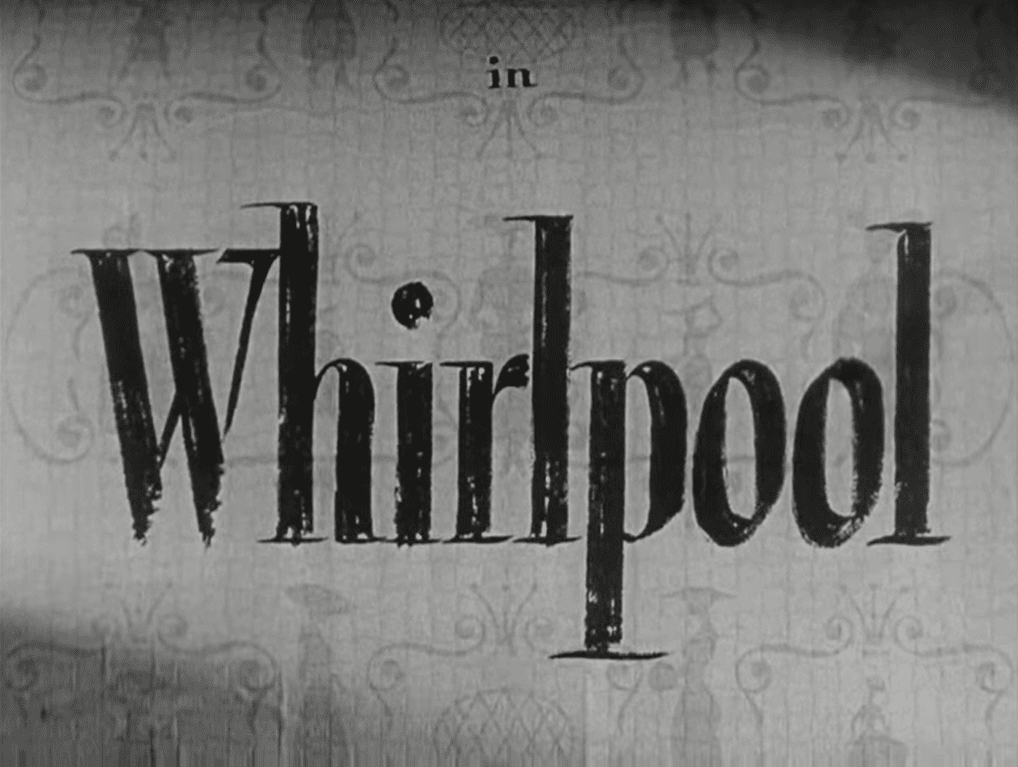
Whirlpool (1949)

Film noir Whirlpool (1950), starring Gene Tierney, Richard Conte and Jose Ferrer, is a masterful summation of some of noir's best tropes around the paranoid woman.

It does however subject the woman to the role of a pawn in a game of power between two competing schools of theories and therapeutic techniques: psychoanalysis and hypnotism.

The film opens with a promising scene in which Gene Tierney, playing the wife of a super-eminent psychoanalysis, is caught stealing a valuable broach from a store. 

Clearly she is able to afford the item she steals, as she lives a massively affluent lifestyle, and so the premise is strong.

However, as we shall see, viewers never get to the bottom of why Gene Tierney's character Ann behaves like this. She is quickly branded a kleptomaniac, and any decent modern film or novel would proceed along the lines of discovering what is at the root of this.

Where the Sidewalk Ends (1950)

Where the sidewalk ends, morality falls away, darkness prevails and in the black folds of the night, nobody can see who’s the good guy and who’s the bad guy.

Where the sidewalk ends, you’re on your own, making your own moral choices, with no guidance other than your past, and your own spur of the moment errors — your own dry, cold and helpless anger, your vendettas.

In this devilish and dangerous land, film noir lives and breathes — and Where the Sidewalk Ends (1950) is an epic film noir, one of the greats. It's a film that drives the cynicism home, before kicking it to death in the garage.

Directed by Otto Preminger and starring Dana Andrews, Gene Tierney and Gary Merrill.

Night and the City (1950)

Jules Dassin's Night and the City (1950) is a cinematic excoriation, a nocturnal fugue of failed aspiration, doomed enterprise, and lurid spectacle. This British-American hybrid noir, directed by an expatriated American director fleeing the sordid tribunal of the House Un-American Activities Committee, coalesces around the jittery figure of Harry Fabian—a human perversion of motion itself. Played with convulsive energy by Richard Widmark, Fabian is a miscreant whose ambition corrodes every surface it touches. In his breathless pursuit of legitimacy through London’s professional wrestling underworld, he performs a danse macabre before the abyss.