Showing posts with label Psychoanalysis. Show all posts

Suddenly, Last Summer (1959)

Suddenly, Last Summer (1959) is an autobiographical Tennesse Williams psychosurgery paranoid woman benevolent aunt madness or truth thinly veiled story about the unspeakable, homosexuality, Southern aristocracy and madness unsung surreal masterpiece of intriguing and twsited based on a play theatricals around a mad sister and a dead son, and a proposed lobotomy, and a pscyhoanalytico-religio-sacrificial erotomania suppression of women symbolic Joseph L. Mankiewicz directed film noir psycho-melodrama starring Katharine Hepburn, Elizabeth Taylor and Montgomery Clift.

Mirage (1965)

Mirage (1965) is an amnesia corporate crime nuclear threat hunted man paranoia thriller film noir, usually called a neo noir by the time we have come to examine the 1960s and its use of the style.

Yes, even though Mirage (1965) was made by Edward Dmytryk in the 1960s it rolls with the full flavour of all iconic and classic film noir, from the paranoiac lost in the city, to the hats and hoods of a mysterious underworld. Great motor cars and docu-noir style street action, a dream-like quality, and mystery intimate quick flashback visions as Gregory Peck pieces the cliches together, with the unique addition of Walther Matthau.

Bewitched (1945)

Bewitched (1945) is a paranoid woman psychological voice-in-her-head voiceover flashback assumed identity psychological terror supernatural schizophrenic medical insane woman fleeing marriage hypnotism flashback and voice over film noir from the dark height of the golden age of the silver screen's era.

The term classic film noir does doubtless evoke as it is intended to do, a series of high powered and famous high stakes noir dramas from the period, usually of eminent structure and production, and preserved by film registries and their buffs, citing such names as Double Indemnity and the rest of the well-trod shuffle of the mighty, while 1945 alone boasts the classics of Detour (1845), Scarlet Street (1945), Mildred Pierce (1945), and The Lost Weekend (1945), yes it's the year that film noir won Best Picture, Best Director, Best Actor and Best Adapted Screenplay at the Academy Awards.

The Night Runner (1957)

The Night Runner (1957) is a social issue mental health exploitation psycho patient in the community murder film noir directed by Abner Biberman and starring Ray Danton as Roy Turner, a psychiatric patient who is released into the community as a bad board level decision made by an overcrowded Californian sanatorium.

As an interesting take on an unusual social issue, The Night Runner is one of a run of film noir B pictures from Universal, offers a unique and intense viewing experience as serious but seriously misunderstood social and medical issues are collided into exploitation fiction. 

Rage in Heaven (1941)

Rage in Heaven (1941) is a mannered psychological jealous love and madness film noir from the early years of the psychological jealous love and madness noir period.

Intimate and wild, formatively dramatic, Rage in Heaven is naturally also served with a twist of vaudeville, because psychological harm was only communicable in this manner at the opening of the era, circa 1940 and 1941.

Psychology is a supernatural form for noir and romance cinema, spoken of in unfounded vagueness and mystery, often in authoritative or awed tones.

The vaudevillian doctors of early psychology are a cinematic class unto themselves and are more prominent and more interesting and contain more semiotic fare in the 1940s, than they do or appear to be in any other decade.

Dial 1119 (1950)

Dial 1119 (1950) is a psychopath hostage film noir starring Marshall Thompson as a sick young man who steals a gun and then takes a group of hostages in a cosy bar rom, tended by William Conrad in one of his rare non-cop nor killer noir roles.

The telephone number "1119" is the police emergency number used in the film, which could be classed as one of several prominent telephone noirs from the golden age of Hollywood cinema.

Delusional mental patient Gunther Wyckoff (Marshall Thompson) escapes from a mental institution, intent on locating psychiatrist Dr. John Faron (Sam Levene), whose testimony sent him to the asylum. 

Wyckoff arrives by bus in the rather interestingly named Terminal City, and as he disembarks, he is confronted by the bus driver for stealing his Colt pistol. Wyckoff uses it to kill the driver.

The Locket (1946)

The Locket (1946) is a noir of nested narratives — a kleptomaniac paranoid psychoanalytic flashback within a flashback film noir which unravels one woman's secret life and haunted past. 

This psychological thriller  directed by John Brahm stars Laraine Day, Brian Aherne, Robert Mitchum, and Gene Raymond, and was released by RKO Pictures. 

The film is based on a screenplay by Sheridan Gibney and adapted from "What Nancy Wanted" by Norma Barzman, wife of later-blacklisted writer Ben Barzman. 

The set up is an interrupted wedding, the stuff of nightmares. John Willis (Gene Raymond) is about to marry bride to be Nancy (Laraine Day), but a man named Harry Blair (Brian Aherne) crashes the wedding. 

Blind Alley (1939)

Blind Alley (1939) is a psychoanalytic home invasion psychopath on the run crime film noir directed by Charles Vidor and stars Chester Morris, Ralph Bellamy and Ann Dvorak. The film was adapted from the Broadway play of the same name by James Warwick.

Blind Alley may well be a fairly unique prospect — it appears to be a fully-enough formed film noir production — produced at a time before the film noir style and approach was fully formed.

In terms of solid film noir elements we do have a few firm foundations in place which must classify Blind Alley as a film noir.

Firstly, Blind Alley features psychoanalysis as the tool which solves the crime, and gets to the bottom of the psychopathic criminal's dilemma.

Spellbound (1945)

Spellbound (1945) is an Alfred Hitchcock romantic psychological amnesia thriller with a noir nuance that cannot be denied. 

In some senses an outlier in the body of Alfred Hitchcock's own work, and not entirely styled in the mode of a more traditional or acceptable example of film noir, Spellbound does carry with it key noir themes of amnesia and psychoanalysis, and is as much a thriller as it is a psychological mystery.

Most of Spellbound's power comes as a romance story — always a strength with Alfred Hitchcock, who was as much a master of amour as he was of suspense.

Spellbound follows a psychoanalyst who falls in love with the new head of the Vermont hospital in which she works, only to find that he is an imposter suffering dissociative amnesia, and potentially, a murderer.

Hollow Triumph (1948)

Hollow Triumph (1948), which is also known as The Scar, and sometimes also by its working title The Man Who Murdered Himself, is a full on fantastical and fun full-fat film noir classic crime film directed by Steve Sekely starring Paul Henreid, Joan Bennett and Leslie Brooks. 

It was released by Eagle-Lion Films, based on the 1946 novel of the same title written by Murray Forbes.

It's everything high noir should be — a story of hardened criminality, deceit, weird and fantastical problems and situations, ambiguity, pursuit, fate, twists and doomed and destructive love affairs — it's incredible what can be packed into this 83 minute ride.

Conflict (1945)

Conflict (1945) is a wife-murder mystery paranoia and psychiatry film noir from the classic noir period, starring Humphrey Bogart, Alexis Smith and Sydney Greenstreet.

Conflict broadcasts its wicked and paranoiac storyline directly from one of the key centres of film noir existence — the middle class suburban marriage. 

These marriages are often writ unhappily across noir, and featured weakened males, bothered by lust for another woman, as in this example, or other forms of unhappy greed.

Conflict opens with such a marriage on display —  a couple who appear to be happily married but in fact are not. And on their fifth wedding anniversary, wife Kathryn (played by Rose Hobart) accuses husband Richard (played by Humphrey Bogart) of having fallen in love with her younger sister, Evelyn.

World weary and as super cynical as ever, Bogart as Richard does not deny it, even though he has resigned himself to leaving things as they are, since Kathryn certainly would not give him a divorce.

Possessed (1947)

Possessed (1947) is high period paranoid woman family mystery amnesiac film noir with complexities galore, and starring Joan Crawford, Van Heflin and Raymond Massey.

Working wonders with the flashback structure, Possessed starts in dramatic style with a woman on the wander through some vacant city streets, murmuring only the name 'David' to herself.

The opening, which punches hard upon the perennial themes of urban isolation and amnesiac or damaged individuals lost within these concreted jungle confines, opens the door to frame an entirely flashback-told story of a woman called Louise Howell, played by Joan Crawford, who is presumably the possessed character of the title.

High Wall (1947)

High Wall (1947) is a wife-murder mystery amnesia psychiatric PTSD ex-serviceman prison noir starring Audrey Totter, Robert Taylor and Herbert Marshall.

From its exciting opening sequence in which ex-mercenary flyer Steven Kenet (Robert Taylor) crashes his car into a river, trying to cover the evident strangulation murder of his wife with a suicide, to its traversing of the prison system for the criminally insane, up until its drug-induced truth-finding denouement, High Wall is exciting, fantastic, serious, dopey and features a proper film noir evil villain, a cool-blooded bad-doer who commits the most callous killings  — in order to save his chances at career promotion within the business of religious book publishing.

The Accused (1949)

The Accused (1949) is a psychology sex-killer-thriller paranoid woman classic from the film noir era, starring Loretta Young as a psychology professor who asks he students to perform sexual-psychological experiments on each other. With disastrous consequences.

The Accused is as essential a film noir one would need as the most extreme example of the othering and socially oppressing of women. It's the ultimate in #metoo noir as well.

The Accused is directed by William Dieterle and adapted to screenplay by Ketti Frings from the novel Be Still, My Love written by June Truesdell. It stars Loretta Young, Robert Cummings, Wendell Corey, Sam Jaffe and Douglas Dick. Music is by Victor Young and cinematography by Milton R. Krasner.

Caught (1949)

Caught (1949) is a film noir melodrama from Max Ophüls starring Barbara Bel Geddes, Robert Ryan and James Mason, laying bare the perils of middle class marriage and the bullying and controlling which waits any eager young bride, keen to live the fantasy life which the magazines of the time were selling.

Caught is a film which appears more vicious the closer we look at it. 

To kick off, we have some young women who are planning to live their lives through catalogues, an excellent introduction to the mating game as America enters the 1950s.

It is stressed over and over again, in fact. Young model Maude, who changes her name to a more charming 'Leonora', played by Barbara Bel Geddes is seen with her friend and flatmate Dorothy (played by Natalie Shafer) constructing the fantasy life she shall lead via the pages of the many magazines and lifestyle publications that occupy their evenings in their rather downbeat and crummy digs.

Whirlpool (1949)

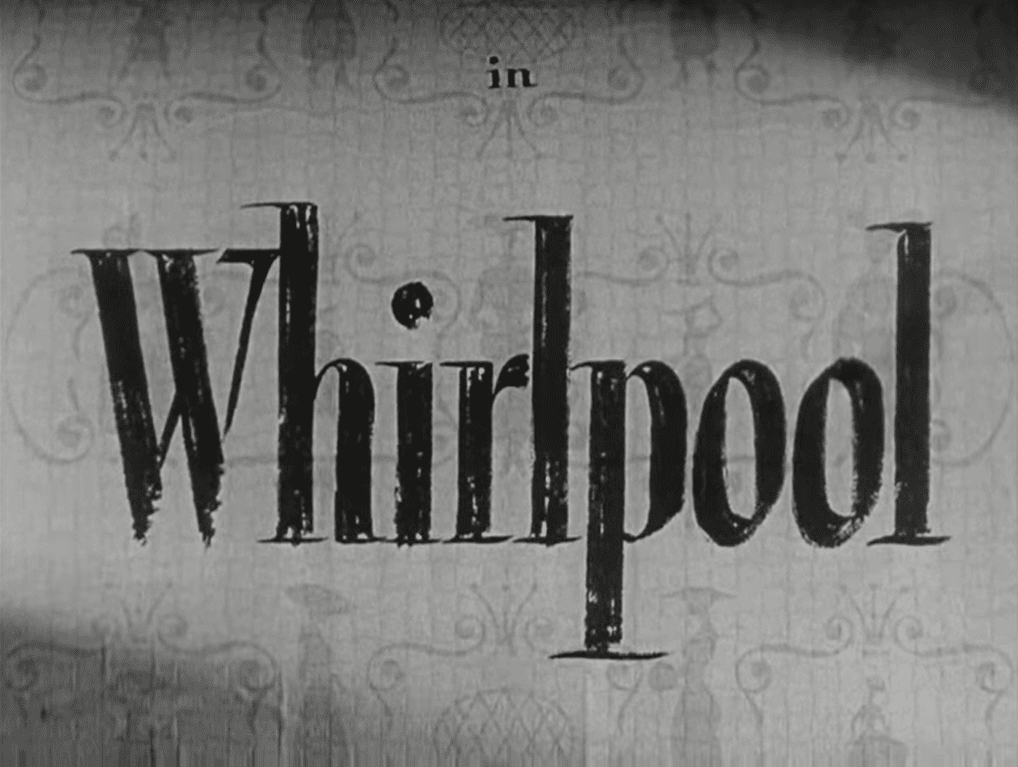
Film noir Whirlpool (1950), starring Gene Tierney, Richard Conte and Jose Ferrer, is a masterful summation of some of noir's best tropes around the paranoid woman.

It does however subject the woman to the role of a pawn in a game of power between two competing schools of theories and therapeutic techniques: psychoanalysis and hypnotism.

The film opens with a promising scene in which Gene Tierney, playing the wife of a super-eminent psychoanalysis, is caught stealing a valuable broach from a store. 

Clearly she is able to afford the item she steals, as she lives a massively affluent lifestyle, and so the premise is strong.

However, as we shall see, viewers never get to the bottom of why Gene Tierney's character Ann behaves like this. She is quickly branded a kleptomaniac, and any decent modern film or novel would proceed along the lines of discovering what is at the root of this.

The Dark Past (1948)

The Dark Past (1948) is one of several films noir which opens with the aerial shot of the city, and an earnest voice over describing the existential experience of the urban life, the technological alienation which is suggestive of an architectural emptiness, a nihilism even, akin to crime in its freedom.

As Side Street seems to open with the message that any one of us may be the day's murder victim as much as they may be that murder's suspect.

The Dark Past takes the more traditional Mark Hellinger informed attitude that this is the naked city, and that it's like a jungle sometimes, and this is our framing, the real life city.

William Holden plays mean as hell psychopath and killer Al Walker, a film noir apogee and the defining casting action of a style which elevated to central protagonist the idea of villain as narrative prime mover.

The Dark Mirror (1946)

There was clearly huge cinematic fun to be had with the special effect which allowed two Olivia de Havilland’s to appear side by side on the same screen.

The name of that film noir fun is The Dark Mirror ― a crazed noir fable from 1946, 

Fun is correct in fact ― when the twins appear side by side for the first time, although the subject in hand is a grisly murder and an obvious deception ― both twins must know exactly which twin committed the murder ― Dimitri Tiomkin’s score turns to a light form of circus music ― and a merry pantomime plays as Thomas Mitchell scratches his head, acts befuddled and effectively says “well I never!” for a full minute.

Mitchell often did play comedy however as a character actor. In fact he was in some of the very best films of the period, including  Lost Horizon (1937); Stagecoach (1939); The Hunchback of Notre Dame (1939); Mr. Smith Goes to Washington (1939); Gone with the Wind (1939); It's a Wonderful Life (1946) and High Noon (1952). He won a Best Supporting Actor Oscar in 1940 for his role as the drunken Doc Boone in John Ford's Stagecoach (1939).

With the comedy dealt with, The Dark Mirror’s next plunge is very film noir indeed ― into psychoanalysis. 

The Woman in the Window (1945)

It’s plastered on thick.   

Fritz Lang’s The Woman in the Window (1944) opens with Edward G. Robinson giving a college lecture, while behind him the words SIGMUND FREUD are written on a blackboard.  

If only he had turned to read that board himself.  

Ten minutes later Joan Bennett, playing the strange femme fatale of the title, turns up in a see-through blouse, and asks him to her apartment to see her etchings. 

That would be enough for many pictures, but in terms of the psychological goodies of film noir, The Woman in the Window probably has it in greater quantities than any other movie of the era.

The story is as fine a descent as featured in any film noir.  After psychology professor Richard Wanley (Edward G. Robinson) sends his wife and two children off on vacation, he sees a striking oil portrait of Alice Reed played by Joan Bennett in a storefront window.

Later, he meets the subject of the portrait, who is standing near the painting watching people gaze at it. Reed convinces Wanley to join her for drink, and thereafter there's murder, shootouts, clues, crime scenes and comic dialogues ... culminating in one of the greatest story-telling cliches of all time.

The Seventh Veil (1945)

The Seventh Veil (1945) is a variety of woman’s film. 

This may sound dismissive but the so-called 'woman's picture' is a sometimes unacknowledged genre from in particular the 1940s, a similarly themed series of films which focus on the mental health of domestic, middle class women. 

Often the women in these films are prisoners, either physcial or mental, or as here ― both. 

Because of this, these heroines are also generally quite paranoid.

You can tell The Seventh Veil is one such ‘paranoid woman film’ because of how it opens ― a woman in a sick bed. 

It’s Ann Todd (playing Francesca) and she is in the traditional pose of the ‘sick’ woman, in a bed, asleep one second, and the next frighteningly alert to the disturbances of her mind. 

It doesn’t matter necessarily that this bed is in a sanatorium ― these beds are just as often in houses, generally creepy, weird houses, but domestic situation nonetheless.