Showing posts with label United Artists. Show all posts

To Be Or Not To Be (1942)

To Be Or Not To Be (1942)
is not a film noir but as it is a theatreland mistaken identity German occupation of Poland romantic satire black comedy caper about the Holocaust, Nazism and Adolf Hitler and as such it is destined to feature on the classic film noir website, and though with little pedigree, wenn es überhaupt etwas ist, dann ist es kein Film Noir!

A comedy and as comedy does not age well of all the products and causes of the works of Hollywood, and of the few directors of the era that have no feet nor fingertips in film noir, Ernst Lubistch has no feet nor fingertips, non in film noir non, none.

An endless matinée, a film that works to eternity, one of the Hitler films and hard to conceive of in light of how magnificent it must be to portray the fascist in film, and there is film noir style, because if the shooting and the price of black and white, relax there is very little.

Ramrod (1947)

Ramrod (1947) is a darkness on the range film noir western tale of bullying double crossing and rivalry from one of the style's favourite directors, André De Toth, one of the pioneers in the film noir western genre jam of the 1940s.

The permutations of film noir began to play across nightmare scenarios in the urban, criminal, historical and now western styles of story telling,.

In the shadow-draped alleys of 1947, it was not all shadow-draped alleys and the Western too felt the noir influence from time to time. This picture called Ramrod hit the silver screen, helmed by the Hungarian maestro Andre de Toth, and is now considered to be an example of cross-over style, that most amazing of constructs, the film noir western.

The Killer Is Loose (1956)

The Killer Is Loose (1956) is a cat and mouse revenge killer on the run suburban family man cop film noir from the cul de sac end of the great mid century American noir cycle.

The Killer Is Loose (1956) is a film noir thriller with modern echoes, although the 1950s had already seen the death of modernism. We may well come back to that.

Yet the cinema has to be the ultimate of all modern artforms. The modern period, insofar as it relates to art, literature and most importantly of all, politics, can really be said to take place between 1880 and 1950.

It is curiously enough during this period also that cinema rises, develops, achieves its potential, and then enters the same decline as all else in post modern period.

Nightmare (1956)

Nightmare (1956) is a tortured male lead psychological thriller mystery film noir directed by Maxwell Shane and starring Edward G. Robinson, Kevin McCarthy and Connie Russell.

It's such a mystery indeed to relate how a man can dream a nightmare and find a key and wash blood off his hands and not know what he has done, such a mystery that the story is told twice in the great film noir era because this same story was told in the film Fear In The Night (1943), also a great example of the style and its obsessions.

Essentially Nightmare (1956) is a tale of paranoia, murder and psychology, making of it noir mania in a deluxe package. Cracking weird action drives our hero played by Kevin McCarthy, doing a bit of what he was to later perfect in Invasion Of The Body Snatchers

Black Tuesday (1954)

Black Tuesday (1954) is a violent death row prison break journalism and media gang on the run sociopathic killer film noir.

Shot on sparing sets and more intense and violent than your average 1954 thriller, Black Tuesday with Edward G. Robinson is one of those noir gems that you hear about.

More than the sum of its parts, Black Tuesday (1954) pulls an epic violent bad guy sociopath role from G. Robinson and does so across some of the most unique set scenery of the day.

The two sets largely used are a set of prison sets, including a shoot out exterior, and plenty high angles looking down staircases and across yards. The electric chair scenes are probably the best across the whole style.

Shield For Murder (1954)

Shield For Murder (1954) is a violent crooked cop bad-lieutenant style savagely enjoyable classic spaghetti cellar film noir starring a heaving Edmond O'Brien as a mentalist officer with a bend on for the dark side.

It's the mid 1950s and all is roaring forward into a bright future, but on the streets of the noir city it's a different story, where one man is bending the American Dream outta shape with every slug, snog and gamble.

A beautiful and even darker twin to the other great bent and copper movie of the moment which was Pushover (1954), with Fred MacMurray and Kim Novak. It's not debatable whether or not you want the cop to get the money and the woman. 

In the brooding corridors of urban noir, Shield for Murder, a collaborative directorial effort helmed by Edmond O'Brien and Howard Koch, thrusts audiences into the visceral underbelly of Los Angeles, where O'Brien's portrayal of a cop gone awry serves as a chilling harbinger of moral decay and nasty noir cop rage.

Crime Of Passion (1957)

Crime Of Passion (1957) is a cops in suburbia story of female subjugation by the American Dream, and the story of how one career woman in love regrets her decision to quit her job in the media and become a housewife.

Many of the favourite flavours of noir are evident in a curiously uncorrupted and happy cop shop whereas the subtle rot of suburban morality that is often unsubtly recorded in film noir is placed on a slow burn beneath the lot of this movie.

The men are the men and the women are the women in this vision of 1950s USA, and most especially of all this is a noir of suburbia, a tale of the middle classes and the stifling inability of the new American Dream to cope with any abnormality in the moral and gender relations of the day.

Sleep, My Love (1948)

Sleep, My Love (1948) is a mid-period amnesia husband wife-murder noir based on a story by the great Leo Rosten.

As the story of a paranoid woman being drugged, hypnotised and gaslit into madness, Sleep, My Love features a host of film noir tropes that were hot in the 1940s.

The star of the show and the subject of the drama is Alison Courtland, a wealthy New Yorker, who hasn't a clue how she ended up waking up screaming on a train bound for Boston. When she phones her husband, Richard, the police listen in and overhear that she had threatened him with a gun.

Guest In The House (1944)

Guest in the House (1944) is a psychological film noir melodrama in which a young manipulative woman moves in with her fiancé's family and turns a happy household against itself.

Guest in the House — which was later re-released under the salacious, demeaning and slightly orgiastic title of Satan in Skirts — was directed by John Brahm and stars Anne Baxter and Ralph Bellamy, with support from Marie McDonald 

In this sensual and somewhat slow-burning domestic film noir fable, the character of Evelyn Heath (Anne Baxter) arrives in the home of the extended family of her smitten fiancé, Dan Proctor (played by Scott McKay) somewhere on the New England coast, hoping for a recuperative summer.

The scenery is reminiscent of many a woman's picture of the era, with high cliffs and crashing waves, the first being suggestive of suicide, and the later suggestive of emotional turmoil.

The Sound of Fury (1950)

The Sound of Fury (1950) is a hard hittin' tale of narcissism, sensational journalism, criminality and mob violence from the very heart of film noir and a classic of its kind.

It's a film that fires on all cylinders and one of the few from the era that still has the power to shock — the full on shocks coming in the final scenes, when a mob gathers to hit a jailhouse. 

In the long build up to this however, there is a full film noir panoply of crime, saps, weak males, money-minded females, a brutal murder that is just as gratuitous and frightening as the justice it inspires, and classic spiral-into-alcoholism that is every bit the quintessential sign of public failure — wrapped up in a hard hittin' tale of crime, punishment and yellow journalism.

The dramatic set up for The Sound of Fury (also known as Try and Get Me!) is a classic of its kind. Frank Lovejoy is the honest family man who is out of work and getting dissed like a jerk wherever he goes. Back home he's got an honest family life in the form of a wife and kid to support  — but there is still a sense there that he is going to crack.

Sweet Smell of Success (1957)

Sweet Smell of Success is a 1957 film noir drama starring Tony Curtis and Burt Lancaster as two men working in the sleazier side of the media in New York, a gossip columnist and a press agent.

The film tells the story of powerful and newspaper columnist J.J. Hunsecker, portrayed by Burt Lancaster and based on Walter Winchell, the syndicated American newspaper gossip columnist and radio news commentator.

Playing JJ Hunsecker with a huge amount of control and menace, Burt Lancaster creates a character who uses his connections to ruin his sister's relationship with a man he deems unworthy of her.

The character of JJ, an unrepentant manipulator in a world of unrepentant manipulators, is based on the real life figure of Walter Winchell, who was well known for this kind of activity.

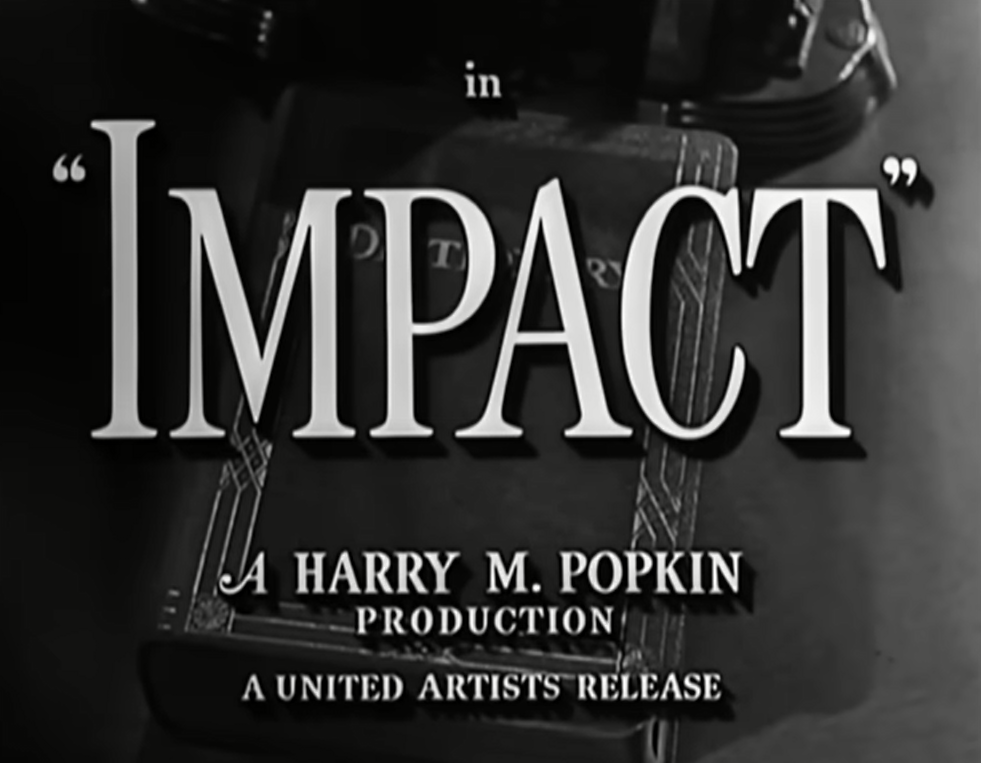
Impact (1949)

Impact (1949) is a film noir classic of confusion, plot twists, identity and love and follows the mishaps and fateful fortunes of industrialist Walter Williams, played by Brian Donlevy.

What makes Impact an impactful film noir as opposed to a plain old drama, is the twisted plot around the successful industrialist's marriage. 

As grouchy as an old bear, his wife sits around at home, the very epitome of the scheming wife, out for what she can get, and of course plotting murder.

A marriage made of monogrammed shirts and pyjamas is helpful for plots like this. Much is made of the bizarre accidentals which lead poor Walter Williams from the heights of success to the lows of small-town isolation, such as the odd device of the domestic assistant Su Lin (played by Anna May Wong) overhearing what she thinks is a threat, when in fact it's a husband larking around with his wife.

The duplicitous wife in Impact (1949) is here writ heavy in the form of Helen Walker, who plays the Irene Williams, the lady behind the plot to kill. Like a good deal of solid noir, Impact is a marriage fantasy, the likes of which 1940s film noir specialised in. 

By this we demonstrate a wife who is so ill-suited that she is planning your murder, and a wannabe love that turns up out of nowhere, already embodying the American dream, and valuing love above cash - a perpetual dilemma. 

Hidden Fear (1957)

Hidden Fear (1957) is something of a curiosity at the tail end of the film noir cycle, and that curiosity largely arises from the fact that it is set in Denmark.

The logic behind this is not clear, and some of the film in general suffers from this lack of clarity too.

Some of the more obvious film noir strings are not pulled, and were it not for John Payne in the lead role, bullying and slapping his way around the Danish capital, there may not be much noir left at all to enjoy.

Hidden Fear is a linear thriller, which does its best to make a virtue of its location shooting, but does not manage to raise any particular tension, or find any depth in its stroll through the Danish underworld.

Storm Fear (1955)

On the run and in the snow ― a lethal combination for those caught in the violence of Storm Fear (1955).

As dramatic set-ups and frequently visited tropes go, the home invasion is as stable a staple as one might wish for, and was perfect for film noir.

There are many examples of home invasion film noirs, from Suddenly (1954), in which Frank Sinatra plays an assassin intent on killing the US President; all the way back to the slightly more conventional The Petrified Forest (1936)

Probably the most famous example of this style of story from the classic film noir period is Key Largo (1948) ― and many of these movies contain the same set-up ― gangsters on the run take over a family home or similar residence, thus creating perfect conditions to explore the inevitable culture clash that crime inspired in the bourgeois imagination.

The Man With The Golden Arm (1955)

The Man with the Golden Arm (1955) is a film noir with  flavours all of its own — whether it be the Saul Bass credits or the theme of heroin addiction — both new elements for 1955 and in their own ways the signs of a new age approaching in cinema.

Frank Sinatra memorably plays the lead in Otto Preminger's adaptation of Nelson Algren's novel, with Kim Novak supplying a sympathetic role beside him, his light indeed in the dark city of film noir, which admittedly is not so very dark here — at least in tone. 

Frank Sinatra plays Frankie Machine, an illegal card dealer and recovering heroin addict who gets out of prison, with a new talent — he's learned the drums. 

On the streets and looking for a jazz band gig, Frankie Machine is inevitably sucked back into the life, encountering all the perils of the familiar noir city — from shady businessmen to vulnerable women, via small-time con men to temptation itself.

The Fearmakers (1958)

The Fearmakers (1958) tells a wonderfully revealing story of war, of advertising and the obfuscation of the line between corporate and government life.

Despite quality issues and any stand out cast performances, The Fearmakers also sounds an early alert concerning the war on the public that has become a ubiquitous feature of modern living.

Because of course, if it was unseen in the 1950s or 1940s, and if it was criminal, psychological and at odds with the public vision, it was going to be a subject of film noir.

There seems something peculiarly prescient about The Fearmakers, even if it is a part of the obsessive hunting of Communists that took over American public and cultural life in the 1950s. 

The real threat to freedom and civil society were already at work in the 1950s however, and The Fearmakers is a great introduction to the science of public relations, which had already been perfected over several decades and through World War Two, before it began to be used out in the open, in the form of political theatre.

Intrigue (1947)

In post-war China, a disgraced former USAF pilot flies smuggled goods into the country. 

He attempts to force his immediate superior, Ramon Perez (Marvin Miller), to pay him more, but Perez resists, so Brad steals the cargo back.

Intrigue (1947) is not featured on the great and many bountiful film noir discussion websites and books because it is a classy example of the film noir style. 

It does however bear repeat viewing, and combines noir underworld themes with geo-politics and American foreign policy, to create an interesting set of circumstances in post-war China ― narrative forming, and not racially aware in a fashion that was not uncommon in the 1940s, although it has no intention to offend.

Intrigue’s intention in fact, as its happy ending ― an element which pulls it away from its underworld noir roots, as well as the rootless and entrepreneurial criminality portrayed by George Raft, as it central character.

Unlike many a noir hero, because he is in fact a  war hero. George Raft as Brad Dunham comes good ― he’s great with the kids, which we see in several quite uncomfortable scenes in which young Chinese actors make jokes about Brooklyn and George Raft ruffles a lot of hair. And there is the happy ending.

This is war after all, and foreign policy. Via the powers of journalism, the morally dubious become virtuous and all star American values are installed.

A Bullet for Joey (1955)

The curious late-cycle film noir gangster-spy picture A Bullet for Joey (1955) unites the two stars Edward G. Robinson and George Raft,  who had previously been paired in Raoul Walsh's Manpower (1941).

Edward G. Robinson was at ease in film noir, and able to play good guy roles, which he often did with pipe-wielding authority, and out and out villains. 
George Raft in A Bullet For Joey plays the hoodlum figure, working here to kidnap a nuclear scientist, with Peter van Eyck as the true ring-leader.

Comparing it to Illegal (1955), also with Robinson and by director Lewis Allen, there is slightly less in terms of dark city noir qualities, paranoia, and psychological damage.

In Montreal, a police inspector (Edward G. Robinson) uncovers piece by piece a plan to kidnap a nuclear physicist. American mobsters, foreign spies and a blonde seductress are all involved in this rather staid caper.

Shout out, however, to monkeys in film noir.

99 River Street (1953)

Down at 99 River Street (1953) meet furious and and pent-up ex-boxer Ernie Driscoll; his devious but gorgeous wife Pauline; Ernie's wife's lover, a sleazy diamond thief whose got a new line in murder; and Ernie's old pal Linda James, an aspiring actress who, almost in the style of Team America ― uses her acting powers to solve the crime.

There, down at 99 River Street is where these all converge, with of course the cops and the diamond fencing gang, who are an especially brutal coterie of evil, with big spade hands for chopping necks and revolvers for the killing slug.

In for the worst weekend of his life, angry former boxer and now full time cabbie Ernie Driscoll lives life on  ropes, when he's not reliving the fatal moment in the ring where he was defeated, felled and retired, all in one series of sucker punches to the eye and gut.

It's likely one of the most definitive film noir set-ups going —  the ex-boxer, living in the shadows of society, struggling with women, struggling with the past, and struggling with crime which seems to be all around him.

We are all in to witness the fantastic escapades that ensue, when Ernie Driscoll takes yet another sucker punch to the guts.

It is supreme film noir fayre.

Rebecca (1940)

Rebecca (1940) is the Alfred Hitchcock masterpiece that won Best Picture and Best Cinematography Oscars in 1940, and was nominated for seven more, and may both be and not be held by those who have a say in these matters to be a film noir.

But if Rebecca is not an example of film noir, what then is Rebecca, with its suspense, mystery, paranoia and brooding atmosphere?

Rebecca in fact while not held as being film noir, does feature many of the aspects of the genre which may be called the paranoid woman film: a young woman, captive in body and mind, lost in a spooky house masquerading as a family home; and a husband who may or may not be homicidal, possibly also even suicidal.

Thing is, in this production, the husband is captive too, which may be a more accurate psychological assessment of marriage. At the very least, Rebecca is a firm and fine example of the paranoid woman genre, and is certainly also to be considered in many aspects as -  an example of film noir.