Showing posts with label Free Film Noir. Show all posts

Jigsaw (1949)

Jigsaw (1949) is an unusual and at times outré mystery chase hate-group propaganda versus journalism, journalism and media film noir, starring Franchot Tone as a detecting assistant district attorney, on the scene and hunting for what might be called neo-fascists, or perhaps simply more likely, just fascists.

None of that was really truly departed for the future, after all, not even by 1949. And what is and was and what became and what now is fascism, and what the definitions of fascism are and might be, are all questions much relevant to film noir.

Jigsaw (1949) is an entertaining thriller that’s so over-the-top, you can’t help but overlook its far-fetched plot and be grateful for the fun it brings. It’s a film that’s as strange as they come.

The Amazing Mr. X (1948)

The Amazing Mr. X (1948) is a 1948 American horror thriller film noir directed by Bernard Vorhaus with cinematography by John Alton. It is also known as The Spiritualist, which is just as well, because nobody in it is called Mr X, or referred top as Mr X, although it's true that it does make a fairly sensational title.

The film tells the story of a phony spiritualist racket, which is rather excellently described with the various tricks of the trade merrily on display, much as they are in fairground noir Nightmare Alley (1947), which also reveals some of the tricks of the trickster's trade in all their shabby glory. 

The film is prominently featured in Alton's book on cinematography Painting with Light (1949) and , the photography does certainly have a full-on film noir feel, with its massive plays of dark and light around doorways and stairways and other architectural corners — including an interesting and repeated shot of the spiritualists at work via the crystal ball — shot from below. Some of the most memorably and recognisable film noir photography on the block.

Another of the stranger angles places the viewer inside a sink.

Raw Deal (1948)

Raw Deal (1948) is a classic of on the lam noir film-making starring Dennis O'Keefe, Claire Trevor and Marsha Hunt.

Prison convict Joe Sullivan has not only taken the fall for an unspecified crime, but he sports the classic film noir overcoat in this film, and runs desperately from hideout to hideout, trekking down the West Coast of the USA on a collision course with revenge.

Best of all, his run is made with two women at his side, Pat and Ann, dames established from the off as the good and bad side of femininity, both of whom are of course sweet on him, in their separate ways.

Pat is the more traditional gangster's moll, who helps Joe with the breakout, and is as tough as the leather which this film noir is made from; contrasted with Ann, the good gal who is her foil and love rival, and is actually Joe's case-worker, who has against her own will fallen for the convict.

The Breaking Point (1950)

The Breaking Point (1950) is a swell of a smart film noir drama that falls sweetly across the boundary between 1040s and 1950s cinema.

The movie stars John Garfield, who plays the otherwise moral captain of a charter boat who becomes financially strapped and is drawn into illegal activities in order to keep up payments on his boat.

Across the varieties of film noir, there are many flavours, and this includes the tragic drama that has elements of film noir, as here in The Breaking Point.

Although not complex, the story is interesting because of the realism brought to the characters, an exchange made in favour of dropping the more familiar and fantastical elements of film noir.

One of the most common themes and juxtapositions in film noir, is made between domestic life and the life of crime, or at least the life 'out there' in the city of danger.

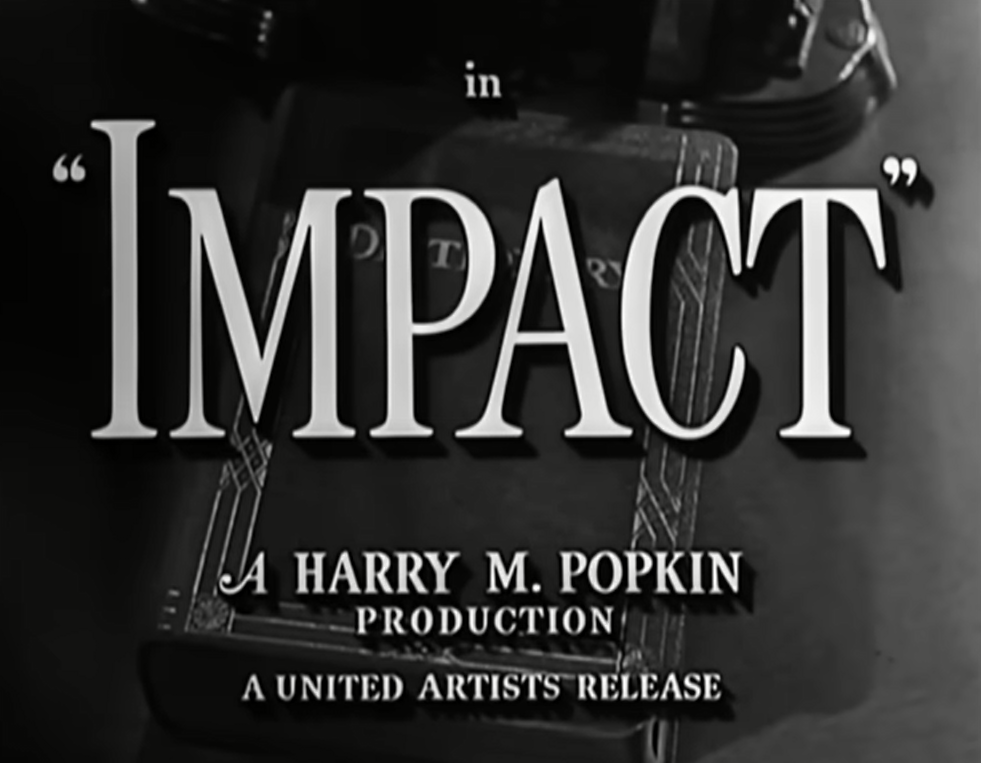
Impact (1949)

Impact (1949) is a film noir classic of confusion, plot twists, identity and love and follows the mishaps and fateful fortunes of industrialist Walter Williams, played by Brian Donlevy.

What makes Impact an impactful film noir as opposed to a plain old drama, is the twisted plot around the successful industrialist's marriage. 

As grouchy as an old bear, his wife sits around at home, the very epitome of the scheming wife, out for what she can get, and of course plotting murder.

A marriage made of monogrammed shirts and pyjamas is helpful for plots like this. Much is made of the bizarre accidentals which lead poor Walter Williams from the heights of success to the lows of small-town isolation, such as the odd device of the domestic assistant Su Lin (played by Anna May Wong) overhearing what she thinks is a threat, when in fact it's a husband larking around with his wife.

The duplicitous wife in Impact (1949) is here writ heavy in the form of Helen Walker, who plays the Irene Williams, the lady behind the plot to kill. Like a good deal of solid noir, Impact is a marriage fantasy, the likes of which 1940s film noir specialised in. 

By this we demonstrate a wife who is so ill-suited that she is planning your murder, and a wannabe love that turns up out of nowhere, already embodying the American dream, and valuing love above cash - a perpetual dilemma. 

Hidden Fear (1957)

Hidden Fear (1957) is something of a curiosity at the tail end of the film noir cycle, and that curiosity largely arises from the fact that it is set in Denmark.

The logic behind this is not clear, and some of the film in general suffers from this lack of clarity too.

Some of the more obvious film noir strings are not pulled, and were it not for John Payne in the lead role, bullying and slapping his way around the Danish capital, there may not be much noir left at all to enjoy.

Hidden Fear is a linear thriller, which does its best to make a virtue of its location shooting, but does not manage to raise any particular tension, or find any depth in its stroll through the Danish underworld.

Decoy (1946)

Decoy (1946) is a low budget, cheaply plotted film noir thriller and shocker, premised on an idea that has elements in common with horror, as it re-animates a dead con in a miraculous escape from death row.

The source of the drama is easily stressed -- it's a box with $400,000 in it, the proceeds of a robbery.

And the leading actor in the villainous and double crossing pursuit of this box, is an energetic and deadly femme fatale performance from Jean Gillie, a British actor in her first American film role.

Actor Jean Gillie had a short, short life and Decoy, for all its ills and budgetary constraints was her penultimate film role.

For a film that doesn't boast much in the way of star performances, or glorious set pieces, Jean Gillie gives a helluva lotta goods in this short and at times brutal film noir.

The Man With The Golden Arm (1955)

The Man with the Golden Arm (1955) is a film noir with  flavours all of its own — whether it be the Saul Bass credits or the theme of heroin addiction — both new elements for 1955 and in their own ways the signs of a new age approaching in cinema.

Frank Sinatra memorably plays the lead in Otto Preminger's adaptation of Nelson Algren's novel, with Kim Novak supplying a sympathetic role beside him, his light indeed in the dark city of film noir, which admittedly is not so very dark here — at least in tone. 

Frank Sinatra plays Frankie Machine, an illegal card dealer and recovering heroin addict who gets out of prison, with a new talent — he's learned the drums. 

On the streets and looking for a jazz band gig, Frankie Machine is inevitably sucked back into the life, encountering all the perils of the familiar noir city — from shady businessmen to vulnerable women, via small-time con men to temptation itself.

For You I Die (1947)

For You I Die (1947) is a low budget thriller of an innocent con on the run.

Kicking off in a sewer, two characters are thrust out of the void and into their own noir universe. 

Tense, nervous, fighting their way from the lowest and worst of all locales, to attain some kind of freedom and decency.

That’s Noir, living in a sewer for three days, desperate and on the run, trying to get some clothes, trying to get some dough, trying to get to San Francisco.

Two of the lowest of the low in the cheapest of the cheapest of sewers are on the run in the land of the free.

And this is where film noir enjoyed taking us in the 1940s. The enjoyment of life is there in other people, in those whom we love and trust. 

Scarlet Street (1945)

Scarlet Street is a 1945 film noir, directed by Fritz Lang, and is one of what you may call Lang's dream film noirs.

The dream film noir is a heady and difficult combination, and was almost exclusively the creation of Fritz Lang, who employed psychology and hidden impulse very well in his work, and did so brilliantly in The Ministry of Fear, with its dream Nazis, and most successfully of all in The Woman in the Window. (1944).

The same applies to many of Fritz Lang's films, such as The Secret Beyond the Door (1947).

Fritz Lang was born to this. Lang was born to mix the heady visuals of the new cinema with the relatively recent findings of psychoanalytic theory. All this amounts to in practice, and in film noir, are dark desires, so-called because they are both illicit and unknown.

Often in film noir, a man seeks to escape domesticity, while at the same time in film noir, a woman often feels trapped by it, subjugated by the commercial forces that were fast growing the world about her.

The Raging Tide (1951)

The Raging Tide (1951) is a terrific and raging and calming and reflective and stormy crime and adventure movie, that likes to think it's a film noir, but actually spends too much time having too much wholesome fun in the traditional business of fishing to earn some fulsome bleak city noir chops.

Still there is enough here for The Raging Tide to get some slices off those chops. 

Those bleak city noir chops! And it mixes them up with some salty salt-of-the-earth sea-chops. 

Richard Conte and Charles Bickford do in fact get soaked by props men spraying them and tossing buckets of water at them. It is that kinda milieu.

And The Raging Tide starts with a murder, a no-nonsense affair in the dark.

Then the murderer is on the run, through that film noir city, bright lights and shadows, raging through the streets. That's perfect, and exactly what you'd want to see of Richard Conte. On the run, in the city, in the dark. C'est noir . . . even if it does end up at sea.

The Man Who Cheated Himself (1950)

The Man Who Cheated Himself (1950)
Jane Wyatt and Lee J. Cobb

The Man Who Cheated Himself, 1950 film noir and available free from archive.org - directed by Felix E. Feist and starring Lee. J. Cobb, Jane Wyatt and John Dall.


For anyone who isn't only enjoying the film noir feel of skid row, but is actually living on skid row and can't afford to rent any movies, free film noir is an invaluable source of entertainment.  

Free in this instance just means free of copyright, but of course this generally means you can watch a bunch of these films on archive.org or on public uploads made to YouTube.

Directors beware. Failure to renew copyright can default your masterpiece to the List of Films in the Public Domain in the USA.

Dark Waters (1944)


Dark Waters (directed by André De Toth, 1944) doesn't follow the obvious conventions we associate with the film noir style, such as the long shadows, the urban setting, the tough guy talk, the femme fatale and the cruelty of fate.  

But these weren't the only aspects of the movement, and although it's not overt in the more traditional noir crime stories of the 1940s and 1950s, Freudian psychology looms large in the cycle, and is pressed to the fore in such hits as The Woman in the Window.

Dark Waters also tips it hat to Freudian therapy, but that should be obvious from the title.  It follows patterns largely established in the hit film Rebecca, and is typical of the paranoid woman film of the time.  

Detour (1945)

Detour (1945) is high noir, low budget and endlessly fascinating.  Like many of Edgar G. Ulmer’s films Detour was shot in 6 days;  ‘Just visualise it,’ said Ulmer, ‘eighty set-ups a day.’  

It’s hard to visualise, but it sure is heroic.  Normally, this approach would produce a clunky and directionless mess, but occasionally as here, it can still produce a gem.  It's what they used to call a 'poverty row quicky', for the high-speed and low-expense of its production, and there is something about this format that really lets the subversive implications of noir rise to the surface.

Detour is a fatalistic road-movie featuring the broke, the dissatisfied and a spade of bad luck.  At heart it’s a tense anti-buddy relationship, between actors Tom Neal and Ann Savage.  It turns out that Detour is also many people's favourite noir, given how bleak and cheap and evil it is. It's twisted in a way that is hard to achieve these days, and what buffs call a 'low-rent masterpiece.' 

Destination Murder (1950)

Destination Murder (1950)
is a blackmail and murder mystery queer-coded cinema-fantasy delivery boy fantasy psychopathic gang leader fantasy female seeker hero classic Edward L. Cahn film and also a classic film noir, by any sane and sober measure of the style, and doubtless listed as such because as far as Edward L. Cahn film noir output goes and is, this must be his noir masterpiece, the most classical and memorable of his out pout in that style and canon, Cahn's classic expression of the classic film noir style, and perfection ahoy.

In the 1940s and 1950s, the female seeker hero was a new twist in storytelling, and she was unique to film noir. 

Destination Murder (1950) is a good time. It is a film of stupidity greed and fo sho sho fire murder. It is not possible to relate any information regarding this cine-fayre without mention of the player piano which is a large part of its attraction.