Showing posts with label Charles Bickford. Show all posts

A Star is Born (1954)

A Star is Born (1954) is a Judy Garland comeback star vehicle musical scratch the surface portrayal of Hollywood stardom and its machinery love story and doomed romance tale of alcohol, fame, and every day studio and star system misogyny, big production piece musical action and suicide and love and success and failure and the scheming folly of the industry that produced it, and while not only not a film noir but emphatically not a noir nor noir film, is still in its narrative and meta-narrative and reflective qualities, one of the darker musicals one might see, in its reflections made upon the place and time of Hollywood at the end of the golden era of the silver screen.

Duel in the Sun (1946)

Our sojourn with Cotten continues softly, its rewards modest, humane, and widely felt. Yes, indeed, this may not be his film, but the Cotten retrospective continues in a tone of soft confidence, gratifying precisely because it does not overreach.

Duel in the Sun (1946) is a big budget, trashy, overblown, fuss and lust in the dust perfect and strange Technicolor violence against women and girls epic ethnically unengaged and super-classic Jennifer Jones ill-informed diegetically failing mainstream meta-normative-narrative and hegemonic conservatism-inducing psychological western family feud and patriarchal posturin' romance fantasy drama David O. Selznick dream cinematic vision directed by King Vidor, with several directors being left uncredited for their work in the film, such as Josef von Sternberg, William Dieterle, William Cameron Menzies, Otto Brower, Sidney Franklin and Selznick himself, while production unit managers Glenn Cook and William McGarry were also uncredited, and starring Jennifer Jones, Joseph Cotten, Gregory Peck, Herbert Marshall, Lillian Gish, Walter Huston, Butterfly McQueen and Lionel Barrymore.

Johnny Belinda (1948)

Johnny Belinda (1948) is a drama which plays with noir and darkish overtones, dealing as it does with a subject matter that was new to the screen in 1948. 

Directed by Jean Negulesco, and based on the 1940 Broadway stage hit of the same name by Elmer Blaney Harris, Johnny Belinda was adapted for the screen by writers Allen Vincent and Irma von Cube.

The story is based on an incident that happened near Harris's summer residence in Fortune Bridge, Bay Fortune, Prince Edward Island. 

The title character is based on the real-life Lydia Dingwell (1852–1931), of Dingwells Mills, Prince Edward Island. The film dramatises the consequences of spreading lies and rumours, and the horror of rape. 

The latter subject had previously been prohibited by the Motion Picture Production Code. Johnny Belinda is therefore often considered to be the first Hollywood film for which the restriction was first relaxed since its implementation in 1934, and as such was controversial at the time of its initial release.

Whirlpool (1949)

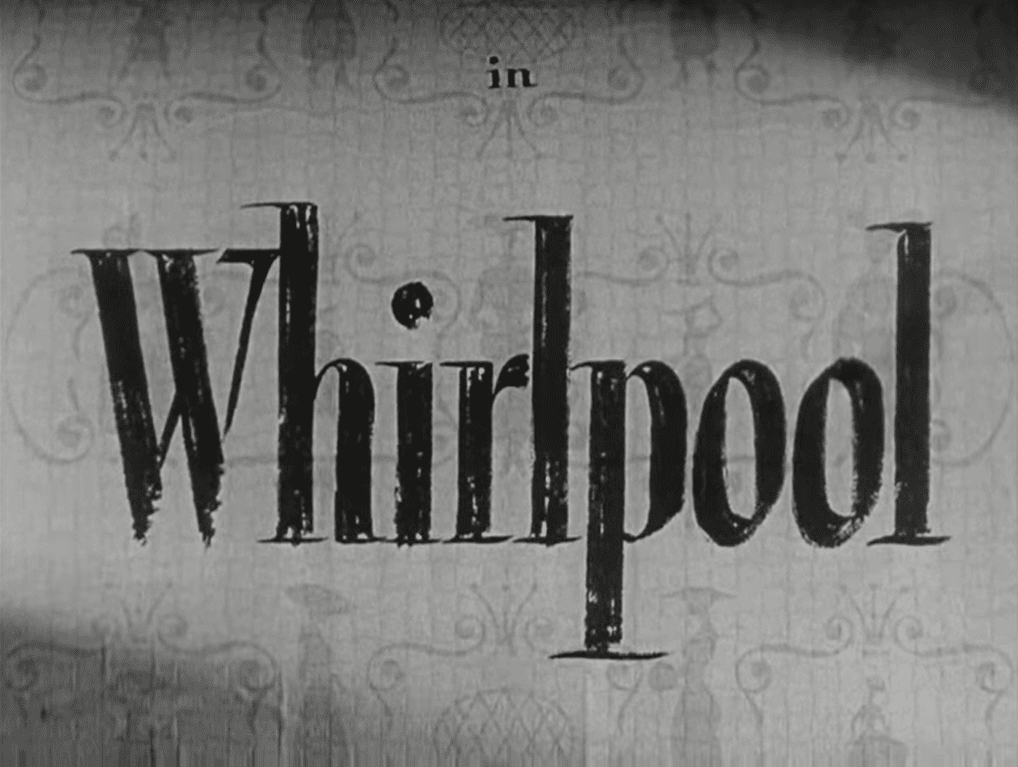
Film noir Whirlpool (1950), starring Gene Tierney, Richard Conte and Jose Ferrer, is a masterful summation of some of noir's best tropes around the paranoid woman.

It does however subject the woman to the role of a pawn in a game of power between two competing schools of theories and therapeutic techniques: psychoanalysis and hypnotism.

The film opens with a promising scene in which Gene Tierney, playing the wife of a super-eminent psychoanalysis, is caught stealing a valuable broach from a store. 

Clearly she is able to afford the item she steals, as she lives a massively affluent lifestyle, and so the premise is strong.

However, as we shall see, viewers never get to the bottom of why Gene Tierney's character Ann behaves like this. She is quickly branded a kleptomaniac, and any decent modern film or novel would proceed along the lines of discovering what is at the root of this.

The Woman on the Beach (1947)

The Woman on the Beach (1947), by Jean Renoir, and starring Joan Bennett, Robert Ryan and Charles Bickford, is a fascinating character study, as well as an appropriately twisted dream-noir, telling of an abusive love triangle, acted out by the sea.

Robert Ryan plays Lieutenant Burnett of the Mounted Coast Guard, and as the film commences, we are launched straight into his nightmares. 

Although it is not made entirely clear what is going on, it is highly likely what is presented is another film noir rendering of what we now know as PTSD. 

Burnett, we witness, has recurring nightmares involving a maritime tragedy. He sees himself immersed in an eerie landscape surrounded by a shipwreck and walking over skeletons at the bottom of the sea while a ghostly blonde woman beckons him. 

C'est noir par la mer!

As Burnett walks towards this ghostly woman, the tension increases, and when they finally meet, then boom! He awakens into an explosion of emotion.

Strange as this is, the story becomes stranger still when he sets out for his day job, which involves patrolling the coast on his black horse.

There on the coast he encounters Joan Bennett, the eponymous woman on the beach, a melancholic and lonely character collecting wood for her meagre fire. And he immediately becomes attracted.

The Raging Tide (1951)

The Raging Tide (1951) is a terrific and raging and calming and reflective and stormy crime and adventure movie, that likes to think it's a film noir, but actually spends too much time having too much wholesome fun in the traditional business of fishing to earn some fulsome bleak city noir chops.

Still there is enough here for The Raging Tide to get some slices off those chops. 

Those bleak city noir chops! And it mixes them up with some salty salt-of-the-earth sea-chops. 

Richard Conte and Charles Bickford do in fact get soaked by props men spraying them and tossing buckets of water at them. It is that kinda milieu.

And The Raging Tide starts with a murder, a no-nonsense affair in the dark.

Then the murderer is on the run, through that film noir city, bright lights and shadows, raging through the streets. That's perfect, and exactly what you'd want to see of Richard Conte. On the run, in the city, in the dark. C'est noir . . . even if it does end up at sea.

Brute Force (1947)

There are four to five hundred stories in the film noir city ― and around two dozen of them are sure-fire, indisputable, authentic classics. 

Brute Force is one of these.

Directed by Jules Dassin, it’s a story from stir ― strong men beat it out of each other as they go crazy behind prison walls. The manliness is multitudinous and the cruelty drives them to the end of their tethers.

Interests collide in a story that is both one man against the system, but also an indictment of the system itself. The cons are grim and the guard is grimmer. The result is a simmering and boiling mass of machismo, acted to within an inch of its life by a cast of glowering guys, who will do anything to survive amid the harsh conditions imposed on them.

Even outside of the canon, this is one of the greatest action, social and thrilling films of its day, with so much to commend the casual viewer, the film noir fanatic, and those generally interested in film. 

Fallen Angel (1945)

"Hey you — I’ve seen the sleeping act before. You know your ticket ran out the last stop!"

With these words a sassy ass bus driver drops off the world’s next noir victim on the outskirts of Walton, and in the middle of the night.

It’s Fallen Angel, a film noir starring Alice Faye, Dana Andrews and Linda Darnell, director Otto Preminger.

Stuck in Walton, 150 miles short of his destination, our anti-hero Dana Andrews wanders into the local diner, where the locals are up to a decent amount of skulduggery, worried about a missing girl called Stella.

It isn’t long before the said floozy breezes in, her legs at a dangerous angle.

She swipes the hero’s hamburger and he exits to wander the streets alone.