Showing posts with label Richard Conte. Show all posts

House of Strangers (1949)

House of Strangers (1951) is a corporate crime Italian-American family drama revenge and rags to riches corruption film noir with fragments of boxing noir and courtroom noir included, which stars Edward G. Robinson as a patriarch in a family of boys who can't sort their succession planning.

Richard Conte is the star of the show and its his story we follow as he smoothly and suavely negotiates this house of would-be strangers, acting as his own father's attorney in the courtroom and beyond, convinced that his rich and domineering banker of a dad is innocent of making his fortune on the backs of the misery of others.

This misery is present as usury, played out by character actor Tito Vuolo, the man who became the stand-by Italian American in many a film noir.

Call Northside 777 (1948)

Call Northside 777 (1948) is a 20th Century Fox journalism and media documentary style innocent man accused prison and investigation crusading reporter classic polygraph classic prison pantechnicon classic film noir, directed by Henry Hathaway and starring James Stewart as the man looking for Wanda Skutnik.

The sub brand of noir known as documentary style film noir is a useful something of a vague category descriptor, although it refers in real terms to the removal of production from sound stages to in many cases the streets and buildings in which events real or based on actuality came to be filmed.

The Sleeping City (1950)

The Sleeping City (1950) is an undercover cop murder metropolitan hospital criminal nurse film noir starring Richard Conte and Coleen Gray, and directed by George Sherman.

Less well known than many inferior film noirs, The Sleeping City does offer a disturbing vision of one of the world's most famous hospitals — Bellevue in New York — in which black market drugs are smuggled out of the hospital in a sting and scam gambling operation.

Richard Conte is the cop who goes undercover, after some suitable screening, and his investigations bring him into contact with a rugged elderly elevator operator, a tormented roommate, and a mysteriously criminal nurse. an authority figure — here the actor Richard Conte — offers some message of public authority and often warning.

Highway Dragnet (1954)

Highway Dragnet (1954) is an innocent male war veteran accused of murder mistaken identity road movie and sexual tension couple on the run thriller film noir, set on the highways and desert areas of Nevada and California.

Highway Dragnet holds the distinction of being the inaugural film to feature Roger Corman in the credits, marking his debut in the industry.

Corman was part of a team of six screenwriters who crafted this tension-filled melodrama shot on location. The film features Richard Conte as a former Marine fleeing from an unjust murder accusation. During his escape, he encounters Joan Bennett, a sophisticated magazine photographer, and her leading model, Wanda Hendrix, as they embark on a cross-country journey. 

Hollywood Story (1951)

Hollywood Story (1951) is a motion picture industry noir killer thriller historic Hollywood mystery drama starring Richard Conte and Julie Adams, Richard Egan, Henry Hull, Fred Clark and Jim Backus, a high host of noir talent.

The murder in Hollywood trope usually takes a film noir twist and usually with a bit of fun. If it ain't In a Lonely Place it will be elsewhere.

Directed by William Castle, Hollywood Story (1951) takes us on a captivating journey through the glitz and shadows of old Hollywood. In a kind of film noir style, with curiosity and nostalgic tableau. Starring Richard Conte and Julie Adams, this American mystery film weaves a tale of ambition, murder, and intrigue.

Whirlpool (1949)

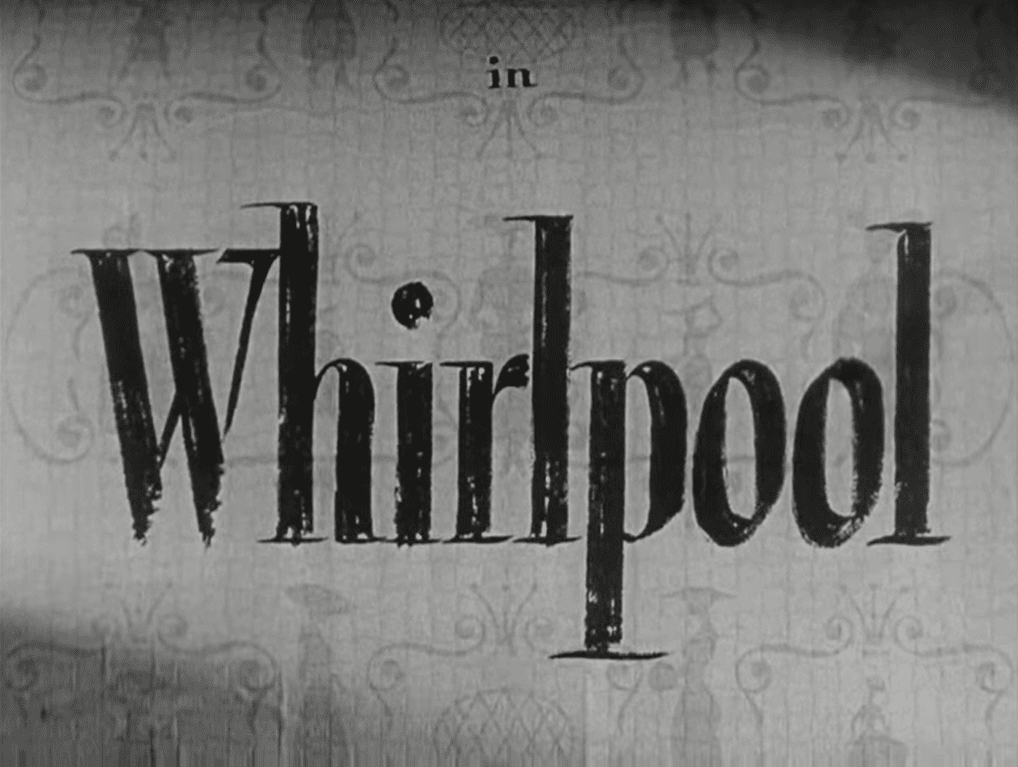
Film noir Whirlpool (1950), starring Gene Tierney, Richard Conte and Jose Ferrer, is a masterful summation of some of noir's best tropes around the paranoid woman.

It does however subject the woman to the role of a pawn in a game of power between two competing schools of theories and therapeutic techniques: psychoanalysis and hypnotism.

The film opens with a promising scene in which Gene Tierney, playing the wife of a super-eminent psychoanalysis, is caught stealing a valuable broach from a store. 

Clearly she is able to afford the item she steals, as she lives a massively affluent lifestyle, and so the premise is strong.

However, as we shall see, viewers never get to the bottom of why Gene Tierney's character Ann behaves like this. She is quickly branded a kleptomaniac, and any decent modern film or novel would proceed along the lines of discovering what is at the root of this.

The Blue Gardenia (1953)

The Blue Gardenia (1953), by Fritz Lang, is a cynical take on how the press handles brutal murder cases. 

Richard Conte is the slick as whistle reporter, determined to prove that the press has more might than the police, and is willing to use his position as the city's ace reporter in order to solve the murder.

Proof, if more were needed, that the mainstream home of any social comment in the 1940s and 1950s could be found in film noir. 

Indeed, the power of the press is as significant as the other beneath-the-surface aspects of the story; and this includes the idea of a woman being drunk equating to some kind of sexual consent.

The Blue Gardenia is the first part of what might be sometimes known as Fritz Lang's 'newspaper noir' trilogy, which also includes While The City Sleeps and Beyond a Reasonable Doubt.

The drunkenness of the pretty young woman played by Anne Baxter in The Blue Gardenia is almost as a form of drink-spiking. Raymond Burr, the womanising press artist at the centre of the tale, is quick to fling a few of his favourite hard beverages down her throat; the Polynesian Pearl Diver, it's called.

She drinks one, she drinks two, and the guzzling with gusto turns sour and a murder is committed.

The Raging Tide (1951)

The Raging Tide (1951) is a terrific and raging and calming and reflective and stormy crime and adventure movie, that likes to think it's a film noir, but actually spends too much time having too much wholesome fun in the traditional business of fishing to earn some fulsome bleak city noir chops.

Still there is enough here for The Raging Tide to get some slices off those chops. 

Those bleak city noir chops! And it mixes them up with some salty salt-of-the-earth sea-chops. 

Richard Conte and Charles Bickford do in fact get soaked by props men spraying them and tossing buckets of water at them. It is that kinda milieu.

And The Raging Tide starts with a murder, a no-nonsense affair in the dark.

Then the murderer is on the run, through that film noir city, bright lights and shadows, raging through the streets. That's perfect, and exactly what you'd want to see of Richard Conte. On the run, in the city, in the dark. C'est noir . . . even if it does end up at sea.

Somewhere in the Night (1946)

From the moment we see John Hodiak’s bandaged faced staring at the field hospital ceiling, we know that Somewhere in the Night is going to be a tale of film noir identity.

Combined with another staple of the style ― the male, recently returned from World War Two, and lost in the city ― Somewhere in the Night (1946) offers true noir chops: the disoriented soul, lost in a city of crime, seeking identity and of course redemption in the arms of a female.

One of several high period film noirs directed by Joseph L.Mankiewicz ― see also Escape (1948) ―House of Strangers (1949) ― No Way Out (1950) and 5 Fingers (1952) ― there is something contained in this mystery that is bursting to be free, and which almost comes loose at several points.

This makes Somewhere in the Night for the most gripping. John Hodiak is the ex-soldier bereft of identity, afloat in the city, seeking himself. He is something of a pinball, bashed from clue to clue as he tries to pick up the trail left by the mysterious Larry Cravat. This is name I read appears to be spoken some 85 times in this movie!

This winds up taking him into an abstruse riddle, focused on the retrieval of some Nazi loot, and through some great locations ― there’s The Cellar nightclub ― and every film noir needs a good nightclub at its heart ― an interesting cabal of thugs who live in an amusingly dressed fortune-telling parlour ― and an insane asylum, another staple haunt of the broken and de-militarised male.

New York Confidential (1955)

In the wake of the televised Kefauver hearings of 1950 (Kefauver Hearings at Mob Museum) which revealed the extent of organised crime in the US to a fascinated public, Broderick Crawford stepped up to camera to play a leading member  of a syndicate, in its Manhattan headquarters.  


Part documentary, part gangster thriller, New York Confidential (1955) (director Russell Rouse, and staring Richard Conte, Ann Bancroft and Broderick Crawford) is played to perfection and has a strong cast. 

New York Confidential almost stands alone.

We're much more used to seeing the corporate gangster these days, but in the mid 1950s, at the tail end of film noir, it was a far harder pitch.

The Big Combo (1955)

The walls and floors are streaked in shadows and there's a noisy boxing match roaring in the city.

Behind the scenes, a girl is pursued down darkly expressionist corridors, with only the self-gratified roar of the crowd as backdrop.

As The Big Combo starts we’re right in there at the heart of the caper, although the real story of The Big Combo is that of Cornel Wilde’s cop, and his obsession with catching the cooly menacing crime lord, Mr Brown, played brilliantly by Richard Conte.

To fulfil its film noir promise, The Big Combo is also hot with slick dialogue, the sort they just don't write no more:

Joe McClure: I guess I'm getting too old to handle a gun.

Mr. Brown: Yeah, maybe you're just getting too old, Joe.

New York Confidential (1955)

New York Confidential (1955)
is a Manhattan hitman action and romancing 'Confidential' series New York on-the-ground corporate crime country club hypocrite political scheming, punch-up shoot-out and dragnet multi-male Kefauver-inspired crime syndicate insider circle of self destruction organized crime politically and judicial bribery criminal cartel classic film noir mobster melodrama by Russell Rouse and starring Broderick Crawford, Anne Bancroft, Marilyn Maxwell, Richard Conte, Mike Mazurki,

New York Confidential (1955) has qualities so numerous with fights and shootings an elevator scene a parking garage scene Broderick Crawford with set dressed sky-scarpers in the background scenes which give the film a lot of confidence, pushy lushes, lushes galore with the lushing of Marilyn Maxwell fairly amongst the greats of the noir lady of sadness and sleaze, the gangster's wife, when the gangster is a skyscraper dwelling man of bullets, matched by the young lushing of Ann Banncroft, incredible exactly like a young Ghislaine Maxwell, suicidal and unable to cope with life as her gangster father's daughter.