
Showing posts with label Mark Hellinger. Show all posts
Showing posts with label Mark Hellinger. Show all posts
The Roaring Twenties (1939)

Knock on Any Door (1949)

Knock on Any Door (1949) is a Nicholas Ray courtroom poverty leads to crime murder and criminality teenage tearaway and suicide during pregnancy flashback and bad boy heart-throb slums and vice and society is to blame from crime movie with one immortal line in it, starring Humphrey Bogart, John Derek, George Macready, Allene Roberts and Barry Kelley.
The Two Mrs Carrolls (1947)

The Two Mrs Carrolls (1947) is a lousy husband paranoid woman blackmail murder and poison mystery manor house art and intrigue infidelity and obsession Mark Hellinger portraits of women in noir film noir starring Barbara Stanwyck, Humphrey Bogart, Alexis Smith and Nigel Bruce.
You might imagine that this melange of mild madness and misty focused love and lust has often been misapprehended as an ungainly hybrid of overwrought melodrama and tepid suspense. Such assessments have become axiomatic, yet they do not withstand close inspection.
Though the film remains aesthetically uneven, it exerts a strange and unrelenting fascination, anchored by peculiar tonal shifts and grotesque exaggerations that reveal, rather than obscure, its psychological acuity.
Manpower (1941)
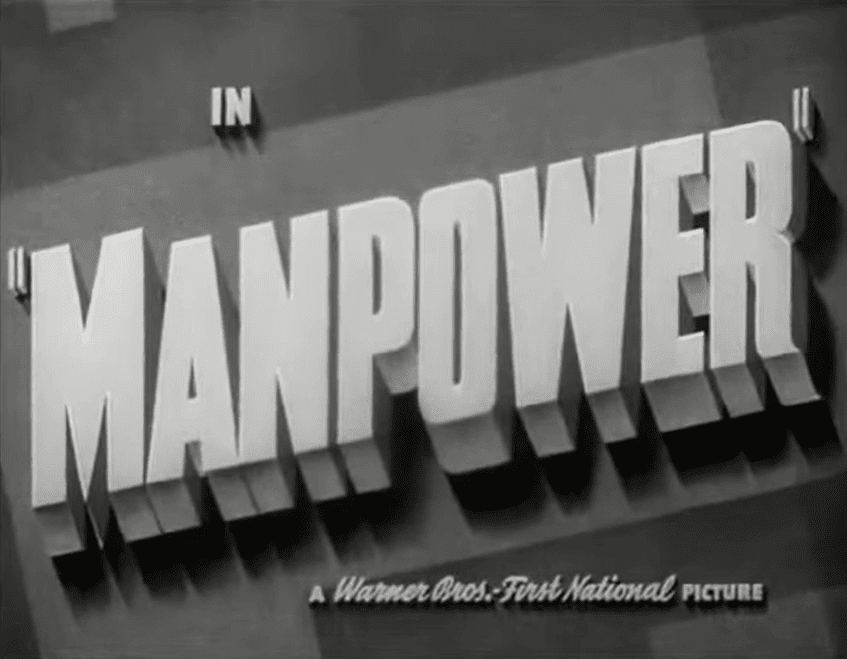
Manpower (1941) starring George Raft, Marlene Dietrich and Edward G. Robinson is deserving of an honourable mention on classic film noir, for the habits it portrays and social directions it takes.
While likely classifiable as a dramatic film with comic elements, Manpower still has something to relate to noir audiences.
The story is about two friends and their supportive relationship, and essentially portrays the bonds between working men and their women.
The slapstick jollity of the era is well captured and has certainly, as comedy usually does, aged poorly. Edward G. Robinson's character in hospital is styled as an 'octopus' because of the way his hands grab the nurses. And this is the least of it.
Brute Force (1947)

There are four to five hundred stories in the film noir city
― and around two dozen of them are sure-fire, indisputable, authentic classics.
Brute Force is one of these.
Directed by Jules Dassin, it’s a story from stir ― strong
men beat it out of each other as they go crazy behind prison walls. The
manliness is multitudinous and the cruelty drives them to the end of their
tethers.
Interests collide in a story that is both one man against the system, but also an indictment of the system itself. The cons are grim and the guard is grimmer. The result is a simmering and boiling mass of machismo, acted to within an inch of its life by a cast of glowering guys, who will do anything to survive amid the harsh conditions imposed on them.
Even outside of the canon, this is one of the greatest action, social and thrilling films of its day, with so much to commend the casual viewer, the film noir fanatic, and those generally interested in film.
High Sierra (1941)

Although High Sierra (1941) is likely perceived by the public as a ‘Humphrey Bogart’ picture, it is not entirely fair to see it that way.
Indeed, High Sierra is notable in many ways for how Ida Lupino’s character develops, and how she is portrayed.
Viewers will also note that Ida has top billing too, before Bogart, and that is worth something!
Critically, Ida Lupino plays a fairly ‘straight’ role here, and hers is not a character the readily fits into the various tropes and stereotypes which it is often said, dominate the female portrayals in the style.
By ‘straight role’ we can confidently say the following of Ida Lupino in High Sierra ― her character is consistent and develops across the course of the action.
While not cast as a femme fatale, or domestic simp of some sort, Ida's character, Marie, falls in love with Humphrey Bogart’s character, Roy, and remains true to the end. The entire episode is presented as her story, and her journey, with the viewer experience being hers.
Conversely, Bogart’s character is typical of a certain type of male from this era of film noir ― he may try to be doing good, but fate and his lower nature are in fact in control.
This means Roy Earle (Bogart) regularly makes wrong decisions, and not just when he is railroaded into them.
The Naked City (1948)

This time yesterday, Jean Dexter was just another pretty girl. But now she’s the marmalade on 10,000 pieces of toast.
In this fashion — by being murdered — this young model becomes one of the stories of The Naked City (1948) which was not just a seminal film noir, but a new departure in many different screen-crafts.
In this fashion — by being murdered — this young model becomes one of the stories of The Naked City (1948) which was not just a seminal film noir, but a new departure in many different screen-crafts.
If you were looking for brave film making in 1948, this was it — cutting edge — innovative and yet sticking to some familiar aspects and techniques, as seen its police procedural and final chase and shoot out.
It was all the inspiration of Mark Hellinger, who was one of the most ground-breaking producers of the time. And directed by Jules Dassin, whose film noirs always appear in critic's top tens.