Showing posts with label Ella Raines. Show all posts

The Walking Hills (1949)

The Walking Hills (1949)
is a hybrid treasure-hunt and hunted man adventure Western film noir in which a disparate cast of archetypes head into Death Valley to look for some lost gold, that they believe to be buried in the sands known as the walking hills, for their ability to shift and change topographical form.

The sand shifts and the land changes, and there is sand blown in storms and sand erodes the hard materials of civilisation, before blowing into people's souls, shovelled into the wind, and there is a shovel fight and a lot of shifty eyes across the campfire, as well as brilliant blues music from Josh White.

The Web (1947)

The Web (1947) is a fast-moving entertaining late-early period and slightly preposterous but fun film noir filler, with Ella Raines, Edmond O'Brien, Vincent Price and William Bendix, so that is certainly a stern and select noiresque collection of faces to do the actin'.

The Web (1947) is in effect a Private Investigator film noir (P.I. Noir) although the character played by Edmond O'Brien is supposed to be a lawyer, although he functions entirely as a P.I,. being hired to be a bodyguard, carrying and using a gun, hanging with his coat collars up in alleyways, and more and more traditional and common P.I. behaviours.

He doesn't get down to none legal work, that is for sure. Other than the top and tail styling back of his maligned blue collar character, played by Tito Vuolo, with typical Vuoloism.

The Strange Affair of Uncle Harry (1945)

The Strange Affair of Uncle Harry (1945) is a jealous invalid-sister paranoid woman small town family murder plot movie which takes the film noir style and its themes off of the city streets and into the middle class homes of a dull New Hampshire mill town.

Historical classical and purest high period Golden Age film noir does have a slight craze for mid century small town mill-centred drama. There are more than a few mill-town noirs. Among The Living (1941) is a classic mill-town noir, as is the amazing Bette Davis noir Beyond The Forest (1949). Purely classic mill town film noir

The Strange Affair of Uncle Harry (1945) and any article about it, or discussion of its noir propensities must always come with an extra spoiler warning, extra to the universal spoiler warning of this website, and your every day moment of film exploration will be shattered if you have not seen this film noir and continue reading this.

Time Out Of Mind (1947)

Time Out Of Mind (1947) is a gothic angst failed artist faux-Gainsborough historical family drama semi-nautical film noir which was not a success in its day, and which retains curiosity for the seasoned noireaux being a Robert Siodmak film, and the certain inclusion of a certain Ella Raines, adored by the fans, for all time.

The film opens with a title card reading Rachel Field's Time Out of Mind and begins with an offscreen narration by the character Kate Fernald, who recounts the return of Chris Fortune from his first sea voyage. 

The production of this film is notable for its behind-the-scenes developments, as detailed in various news items. It's also notable for a certain lack of popularity among the guardians of noirish good taste, which makes it perennially ripe for reappraisal.

A Dangerous Profession (1949)


A Dangerous Profession (1949)
is a stylised pulp cop versus bail-bondsman versus client stand-off romance crime and detective mystery mannered film noir directed by Ted Tetzlaff, and starring Ella Raines, George Raft, Jim Backus and Pat O'Brien.

The tough loners of film noir are always waiting for a new case in the city of crime, whether they be detective or heel, or in this case a bail bondsman, something of the perfect cinematic loner. 

Some of them are waiting for the return of the woman that burned them, and George Raft plays both, with his usual stillness and impassive stone hard cinematic stare.

In the game of sucker moves, this loner works his broken relationships with broken noir charm, the grimaces of both his current partner and his former police partner testify to this.

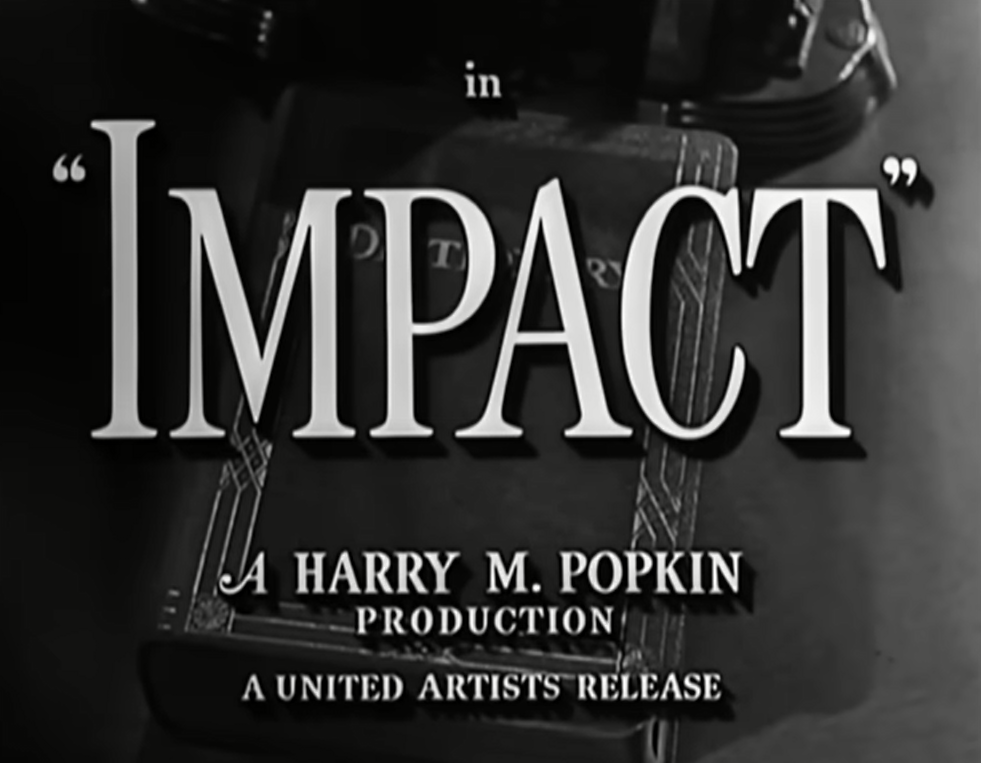
Impact (1949)

Impact (1949) is a film noir classic of confusion, plot twists, identity and love and follows the mishaps and fateful fortunes of industrialist Walter Williams, played by Brian Donlevy.

What makes Impact an impactful film noir as opposed to a plain old drama, is the twisted plot around the successful industrialist's marriage. 

As grouchy as an old bear, his wife sits around at home, the very epitome of the scheming wife, out for what she can get, and of course plotting murder.

A marriage made of monogrammed shirts and pyjamas is helpful for plots like this. Much is made of the bizarre accidentals which lead poor Walter Williams from the heights of success to the lows of small-town isolation, such as the odd device of the domestic assistant Su Lin (played by Anna May Wong) overhearing what she thinks is a threat, when in fact it's a husband larking around with his wife.

The duplicitous wife in Impact (1949) is here writ heavy in the form of Helen Walker, who plays the Irene Williams, the lady behind the plot to kill. Like a good deal of solid noir, Impact is a marriage fantasy, the likes of which 1940s film noir specialised in. 

By this we demonstrate a wife who is so ill-suited that she is planning your murder, and a wannabe love that turns up out of nowhere, already embodying the American dream, and valuing love above cash - a perpetual dilemma. 

Brute Force (1947)

There are four to five hundred stories in the film noir city ― and around two dozen of them are sure-fire, indisputable, authentic classics. 

Brute Force is one of these.

Directed by Jules Dassin, it’s a story from stir ― strong men beat it out of each other as they go crazy behind prison walls. The manliness is multitudinous and the cruelty drives them to the end of their tethers.

Interests collide in a story that is both one man against the system, but also an indictment of the system itself. The cons are grim and the guard is grimmer. The result is a simmering and boiling mass of machismo, acted to within an inch of its life by a cast of glowering guys, who will do anything to survive amid the harsh conditions imposed on them.

Even outside of the canon, this is one of the greatest action, social and thrilling films of its day, with so much to commend the casual viewer, the film noir fanatic, and those generally interested in film. 

The Suspect (1944)

In London in 1902, An unhappily married Charles Laughton falls for a delightfully prim Ella Raines.

The result ― is MURDER.

At least that is the conclusion of the police force, in The Suspect (1944), a faintly suspect film noir in its own right, and a movie which relies heavily on the talents of the two leads, Charles Laughton and Ella Raines.

It is in fact difficult to see what might be left to enjoy, were these two high quality talents were to be removed form The Suspect, and replaced with lesser mortals.

Charles Laughton was always a star, and enlivened any production he appeared in, even if it were as pedestrian as this one. And Ella Raines has her own star quality ― not just her grace and beauty, but communicative skills which shine across the decades, giving her a uniquely compelling quality ― unique because it is not based on either sex appeal, or some lurking maternal quality.

And that is unique, and perhaps something to be celebrated.

Phantom Lady (1944)

Phantom Lady (1944) is a classic wrongfully accused lousy husband fantasy murder mystery film noir, a  luckless, dark and erotic tale of crime, generally in what is known as society’s underbelly.  

In Phantom Lady (Robert Siodmark, 1944, starring Franchot Tone, Ella Raines, Alan Curtis, Elisha Cook, Jr, Thomas Gomez and Regis Toomey) we have all of that on show, and more  

It’s one of the most purely enjoyable film noirs out there — unpretentious, fast and pleasing to watch. 

It has a frantic ‘rape by jazz’ drum scene that is famed through all cinema, and is a high point of the sub-style which we may carelessly call The Female Seeker Hero noir.