Showing posts with label Marlene Dietrich. Show all posts

Golden Earrings (1947)

Golden Earrings (1947) is an immediatley post-war wartime Romany-gypsy adventure transformation prisoner of war with shades of screwball comedy in the shape of a misbehaving wild sexpot gypsy espionage kind of backdrop infused film noir flashback but no voiceover man on the run and behind enemy lines Eurowaldian soundtage based romancer flick about a man and a 'gypsy' who is at odds with English morality, obviously, and who drives a cliched caravan through Nazi Germany with the SS in cold pursuit, ultimately creating a fusion genre that could be described by the phrase serious comedy, and starring Ray Milland and Marlene Dietrich, with Murvyn Vye, Bruce Lester and Dennis Hoey.

Rancho Notorious (1952)

Rancho Notorious (1952) is a Fritz Lang female boss violence against women, rape, hate, murder and revenge western pursuit and narrative themes detection and deduction and lustful romance, incidental 'Chuck-a-Luck' music outlaw atmospheric hideaway Technicolor sexy and smouldering one woman and about twenty men pulp adventure starring Marlene Dietrich, Arthur Kennedy, George Reeves and Jack Elam.

Well, the title song promises hate, murder and revenge so this is clearly a noir-inflected product of the cinematic studio.

Witness for the Prosecution (1957)

Witness for the Prosecution (1957) is a Billy Wilder classic court room drama classic film noir murder suspenser did he or didn't he? Hitchcockian love-that-Laughton Agatha Christie mystery plot twister puzzle game millinery-provoking murder character and melodrama film noir production based on a play and starring Marlene Dietrich, Elsa Lanchester, Tyrone Power, Charles Laughton, Ian Wolfe and Henry Daniell.

Touch of Evil (1958)

Touch of Evil (1958) is an Orson Welles late noir period border-hopping cinema-literate classic film noir marvel of visual architecture and one of the high cathedrals of twentieth-century film, an orgy of chiaroscuro light and shadow, carefully calculated mise-en-scène, and baroque camera movements so aggressive they seem on the verge of toppling the frame. 

If it lacks the gravitas of Welles' debut, it compensates by revealing a director entirely freed from the burden of prestige, indulging instead in excess, sleaze, formal genius, and creative destruction. It is a masterclass in cinematic rule-breaking that turns every aesthetic choice into a moral judgment.

A Foreign Affair (1948)

A Foreign Affair (1948) is a post-war light-hearted romantic comedy Trümmerfilm combining political commentary and goofy-style humour-infused look at the rebuilding of Berlin and the construction of Western narratives around the destruction and villainy of the World War of the 1940s. 

A Foreign Affair is a genuine American Trümmerfilm and cinematic exploration of life in post-World War II Berlin, occupied by the Allies during the early stages of the Cold War. Featuring an ensemble cast led by Jean Arthur, Marlene Dietrich, and John Lund, the film is set against the complex backdrop of a city still reeling from the aftermath of the war. 

Stage Fright (1950)

Stage Fright (1950) is an Alfred Hitchcock British female seeker hero theatre-land murder mystery starring Jane Wyman, Richard Todd, Alistair Sim and wow yes fans, it is Marlene Dietrich.

After the triumphs of his American films, Alfred Hitchcock returned to his roots with Stage Fright (1950), set largely in the theatrical world of post-war London. Based on Selwyn Jepson’s novel Man Running, the project marked Hitchcock’s attempt to merge his fascination with the stage with his penchant for suspense. The screenplay, adapted by his wife Alma and playwright James Bridie, promised a compelling tale of murder, deception, and performance, but the resulting film revealed both creative successes and notable flaws.

Jigsaw (1949)

Jigsaw (1949) is an unusual and at times outré mystery chase hate-group propaganda versus journalism, journalism and media film noir, starring Franchot Tone as a detecting assistant district attorney, on the scene and hunting for what might be called neo-fascists, or perhaps simply more likely, just fascists.

None of that was really truly departed for the future, after all, not even by 1949. And what is and was and what became and what now is fascism, and what the definitions of fascism are and might be, are all questions much relevant to film noir.

Jigsaw (1949) is an entertaining thriller that’s so over-the-top, you can’t help but overlook its far-fetched plot and be grateful for the fun it brings. It’s a film that’s as strange as they come.

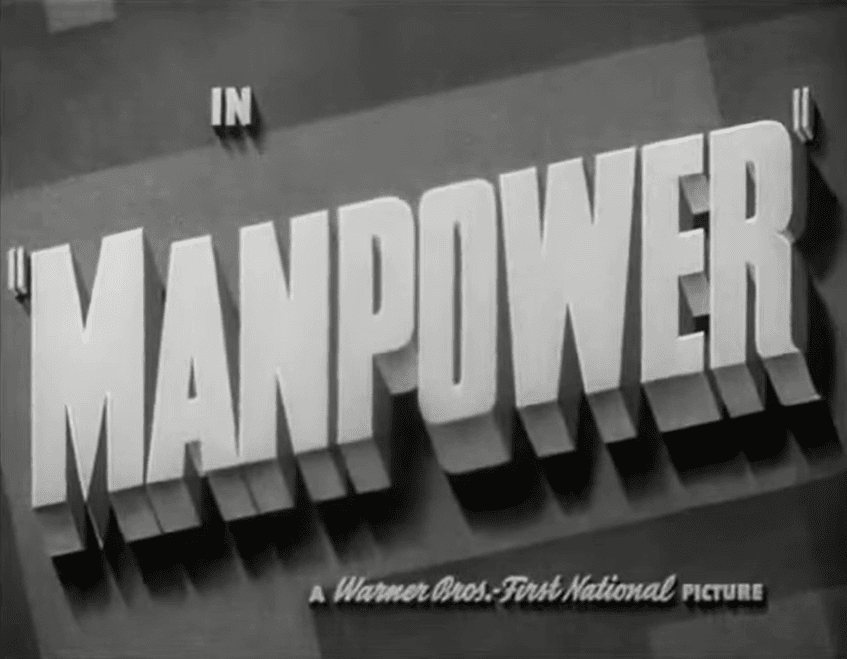
Manpower (1941)

Manpower (1941) starring George Raft, Marlene Dietrich and Edward G. Robinson is deserving of an honourable mention on classic film noir, for the habits it portrays and social directions  it takes.

While likely classifiable as a dramatic film with comic elements, Manpower still has something to relate to noir audiences. 

The story is about two friends and their supportive relationship, and essentially portrays the bonds between working men and their women. 

The slapstick jollity of the era is well captured and has certainly, as comedy usually does, aged poorly. Edward G. Robinson's character in hospital is styled as an 'octopus' because of the way his hands grab the nurses. And this is the least of it.