Showing posts with label British film noir. Show all posts

The Master Plan (1955)

The Master Plan (1955) is a Cold War amnesia spy military paranoia post-Korean war mind-control McCarthy era blacklist ahead of its time Limey noir made by Cy Endfield, already exiled from America and resettling within the British film industry.

The Master Plan (1955) is another circa 1955 thriller loss mysteries which open on a transatlantic flight in 'you are American!' mid air kind of whimsy arriving in an all too wrong England, it is sufficient of a noir trope to be expressive for decades, the Korean War is also mentioned in passing quoting banter, while they still also have the overgrown headaches from what they call already the last war.

36 Hours, or as it is daftly or is it deftly otherwise known Terror Street own start this way these characters we meet on the plane, it's the same with another Cy Endfield fun piece from the exact same time, and no surprising because he did fly into England in intrigue and who knows, maybe even disappointment at the old boys of the OSS back home, rooting out the communists.

Hell Drivers (1957)

Hell Drivers (1957) is a blue-collar ex-con high energy British exploitation truck noir tale of violence, corruption and the unscrupulous carriage of aggregates across small distances within the British countryside.

Stanley Baker as per the script of this still popular tale of truckery does the ex-con going straight routine with heavy nods and grave expressions from start to finish, indicating that he has been 'away' and that he has been living 'here and there' and doing 'this and that' while being from 'around' and having lived at 'around' for several years.

It isn't really full explained what this ex-con with an upright galvanised steel morality did to wind up in prison, but we know that because of his escapade he did one year of time, although more meaningfully, it seems that his younger — brother played by the mysterious Klae Corporation's very own invisible man David McCallum — seems to have been permanently injured during the crime, and reduced to working in his mother's Welsh corner shop for life.

The Limping Man (1953)

The Limping Man (1953) is a murder and blackmail American in England post-war mystery thriller film noir from Cy Endfield and starring Lloyd Bridges, and one with a classic unwelcome and rather dire trope ending which renders most of it somewhat pointless.

Terror Street, which is also 1953, and starring Dan Duryea is quite a similar production in many respects. There is first the trope of the American in England, a man who spreads glamour wherever he goes.

Both films of course commence in mid air, as the American hero lands in London, ready for action, love and mystery. Both films unravel in a leading mystery across the city, joined by the police, but focused on uncertain crimes and small culture clashes.

She Played With Fire (1957)

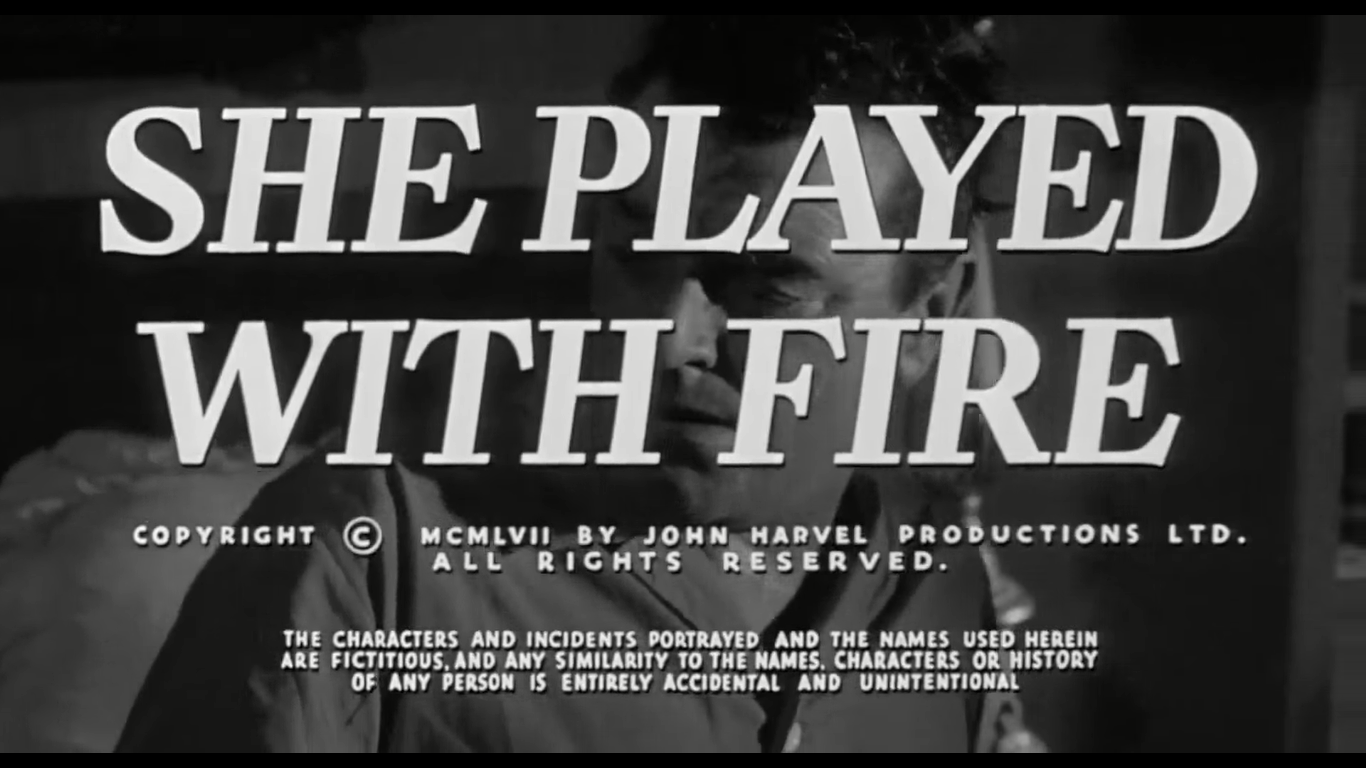
She Played With Fire (1957) is a psychological Limey thriller noir sort of Brit insurance fraud melodrama mystery with widespread stiff upper lippery and confusion raining doubt on a lovely couple of paranoiacs.

She Played with Fire, also known as Fortune Is a Woman, is a captivating British-American film noir from 1957, directed by Sidney Gilliat. The film stars Jack Hawkins as Oliver Branwell, an insurance investigator who finds himself entangled in a web of arson, blackmail, and murder after a chance encounter with an old flame, Sarah Moreton, played by Arlene Dahl.

The Shop at Sly Corner (1947)

The Shop at Sly Corner (1949) is a lightweight Limey mystery film noir with a pleasant historical creep factor and an antiques business setting, featuring a psychopathic Pinkie-like young shop boy on a noir rise to power over the mild mannered walrus faced character actor stylings of Oscar Homoloka

The Shop at Sly Corner is based on a play by Edward Percy, a Conservative MP, which debuted in London in May 1945 and received positive reviews, with Variety praising it as "good theatre." 

The play enjoyed a successful two-year run in London, generating a significant profit for its investors after an initial production cost of just $12,000. 

Brighton Rock (1948)

Brighton Rock (1948) is a classic limey gangland early youth violence exploitation and murder film noir, and a classic of the style, a classic of British cinema, a classic of the cinema of Graham Greene, and a ground-breaking and block-rocking belter of its day, offering some of the purest cinema of the post-war British age.

And this in a classic Graham Greene pre-war tale, a combination of multiple efforts of genius to create a quite uniquely British noir experience.

One will be warned that entire books have been written about the film of Brighton Rock (1948) and even about Richard Attenborough’s ran-sackingly riveting portrayal of Pinkie Brown. 

The Fallen Idol (1948)

The Fallen Idol (1948)
is a child's-view psychological mystery Limey classic film noir thriller which delights in a great script, a fascinating and compelling story, top drawer acting from the very best of the age, and is a general talent-mix of both Carol Reed and Graham Green, both at their cinematic best.

The eyes of a child are untrained in perceiving the grey between the morality of black and white. It is on this precarious naivety of youth that Carol Reed hangs the suspense of The Fallen Idol.

Reed, in collaboration with novelist and screenwriter Graham Greene, crafted The Fallen Idol a year before their masterpiece The Third Man. While The Fallen Idol might seem to suggest adolescent growing pains, your assumptions deceive you. The film is nearly as much a noir classic as Reed's Odd Man Out and The Third Man, which bookend it in his all-too-classic none-too-shabby all-so-awesome filmography.

Eight O'Clock Walk (1954)

Eight O'Clock Walk (1954) is an anti-capital punishment limey-noir in which an innocent bourgeois is catapulted into the justice system after circumstantially being held to be the murderer of a small girl.

Directed by Lance Comfort and starring Richard Attenborough, Cathy O'Donnell, Derek Farr and Maurice Denham, Eight O'Clock Walk (1954) is a fairly solid example of how the British adapted common film noir themes to their own place, time and circumstances, with a taste of the post-war era and British theatrics in an extended look into the legal procedures of a murder trial than is usual in a film of this type.

Based on a true story, Eight O'Clock Walk is an anti-capital punishment film — the title refers to the hour at which executions were traditionally carried out — that highlights the danger of circumstantial evidence resulting in the death of a mistakenly accused prisoner. 

Bad Blonde (1953)

Bad Blonde (1953) is a British boxing noir, with the rough and tumble of the Cockney United Kingdom and the fearsome blonde posturing of Barbara Peyton as a limey femme fatale, successful putting champion boxer Tony Wright — east end good-looker and amateur to pro face-thwacker Johnny Flanagan — off his stroke.

Sid James is super effective as the powerful and charismatic coach with the wisdom of the ages in his cackle, and Frederick Valk plays an unfortunately super-hammed Italian caricature throughout, at a high pitch, playing the solid cuck.

He is a lousy husband of British noir, about to lose his beautiful wife. It's not an uncommon notion in film noir but here it's happening in the god-awful crummy UK, making their own inimitably crummy boxing movie with a lot of energy and manners.

River Beat (1954)

River Beat (1954) starring Phyllis Kirk and directed by Guy Green, is a 1954 Limey Noir about a young woman who winds up embroiled in a smuggling operation on The Thames.

As a working example of British film noir, River Beat features some period pub going, some post-war  London and some boat chases up and down the river Thames, as well as some slum-dwelling characters trying to get by with petty crime among the petty grime.

From its opening powerful drumbeats River Beat is a spritely energetic British medley of themes around love, crime and the big bad worlds of London docklands and having a job on the open seas. Young radio operator Judy Roberts is on shore leave in London, heading for a quaint pub in Wapping. 

Even nearly ten years on from the end of the conflict, River Beat feels peculiarly post-war in its style. On the thrumming waters of The Thames, river cops cruise the talent likening ladies to ships and ships to ladies. It's a quiet day on the waters and it's the way the River Beat likes it.

Odd Man Out (1947)

Odd Man Out (1947) by Carol Reed and starring James Mason is a classic British film noir set largely on the streets of Belfast, Northern Ireland, following one man's episodic flight in the night, as he evades the law, while partially aided in his delirious and wounded state, by a variety of comrades, sympathetic locals and other colourful characters.

The noir chops of this outstanding thriller are evident first in the central character of Johnny McQueen, who is a sympathetic villain — almost a double villain if this is a permissible description.

As a handsome and wounded hero pulling off a passable Irish accent, James Mason is fully sympathetic despite his being both an armed robber and a terrorist — the latter at least in the eyes of the state.

The noir feel is further evident in the photography which is stunning in its use of shadows and light on the streets, corners and alleyways. These in fact do presage the similar, more famous and more elaborate work done by Carol Reed in the film The Third Man (1949), which was filmed two years later than this. 

Man Bait (1952)

Man Bait (1952) is an exceptionally literal title for a film that appeared with several different titles ― none of which were any cop in the film noir title stakes. 

With every passing year, as film grew in popularity as a method of impregnating global minds with ideas of sexuality, more morality for girls was forged on the screen.

Sexuality was in the air, and film noir tells of its dangers, the dangers of crime and crime's links to sexuality; it tells of of sexuality and sexuality's links to crime; noir tells of sexuality's exposure of male morals to catastrophically attractive female beauty, and everybody's inability to cope with the results.

This is in fact what film noir does best; it destroys the surface currents which pull us a long, dragging hapless males and sexualised females to the bottom of a vortex from where no one will emerge happily married.